
Education
Great Wall of China: How Long is it + Fun Quiz

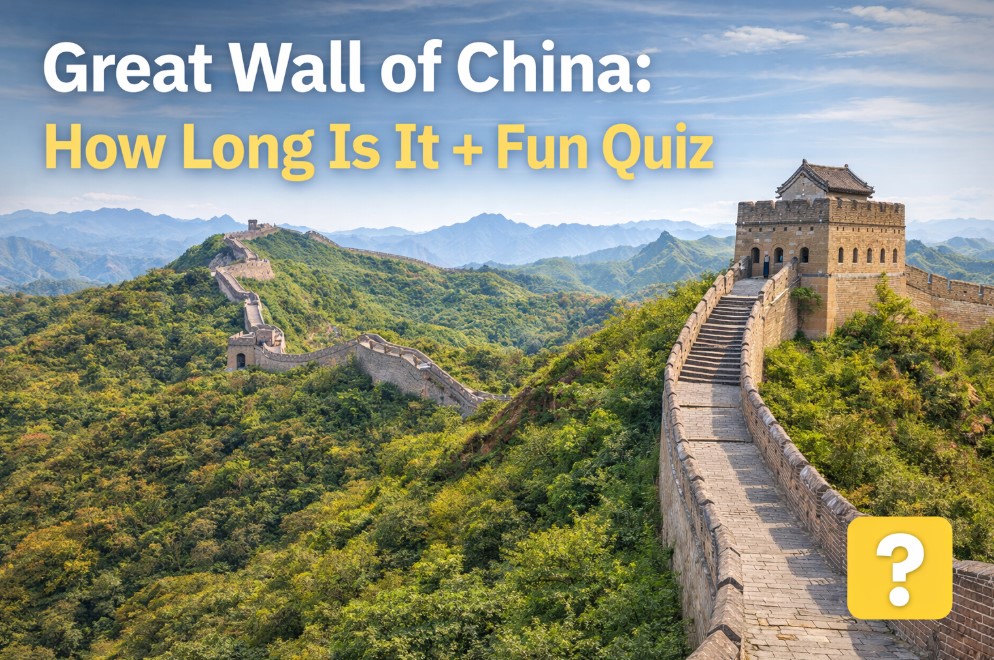
The Great Wall of China is one of the most famous worldwide landmarks. It spans the whole of the north of China and is a symbol of centuries of history, engineering, and cultural enhancements. The questions that many people may have are what its real size is, what its purpose is,s and how it was constructed. Another question that is posed is the length of the Great Wall of China and the reason why it is still relevant today. This paper discusses the history, construction, length, and meaning of the wall in clear and simple terminology. In the end, there will be a brief quiz to check your understanding as well.
History and Purpose
The building was not constructed as a whole. The Chinese dynasties had built different parts over a host of centuries. The walls were first constructed over 2,000 years ago during the time of the Warring States. These initial fortifications were constructed of rammed earth, and they were meant to defend individual states against invasion.
In 221 BCE, Emperor Qin Shi Huang commissioned the linking and adding of the walls that were already in existence when the Qin Dynasty unified China. This was the beginning of the large-scale attempt at forming a continuous defensive line. Subsequent dynasties still rebuilt and reinforced the structure, particularly the Han and Ming dynasties.
The primary goal of the wall was protection. It was constructed to safeguard farmlands and commercial paths against attacks by the nomadic communities in the North. It was also used in defense, in addition to controlling trade and managing immigration,n as well as sending military messages using watchtowers and beacon fires.
Construction and Materials
Construction methods changed depending on the time period and the location. Early sections were built using rammed earth and wooden frames. Workers packed soil tightly between wooden boards to create strong walls.
During the Ming Dynasty, construction became more advanced. Bricks and stone blocks were used instead of only earth. This made the structure stronger and more durable. The Ming sections are the parts most visitors see today.
The wall includes several important features:
- Watchtowerare s placed at regular intervals for surveillance
- Beacon towers used to send smoke signals
- Fortresses located at strategic mountain passes
- Barracks and storage rooms for soldiers
Building the wall required a large workforce. Soldiers, laborers, farmers, and prisoners were all involved. The work was physically demanding, especially in mountainous areas. Despite the difficulty, the project continued for centuries.
How Long Is It?
Most people wonder about the length of great wall of China since most people tend to misinterpret its actual size. The response would be dependent on what is being measured. A survey carried out by Chinese authorities in 2012 revealed that the total distance of all sections constructed by various dynasties amounts to approximately 21,196 kilometers, and this corresponds to approximately 13,171 miles.
This total includes:
- Main walls
- Geographical obstacles like rivers and mountains.
- Trenches and other defensive works.
The most renowned and the most well-preserved parts, which are primarily from the Ming era, are approximately 8,850 kilometers in terms of natural feature counts.
To put it into perspective, 21, 196 kilometers is greater than the distance between the east and the west of the United States. Nevertheless, one should keep in mind that the wall is not one long straight line. It consists of numerous interconnected and detached parts constructed in the course of time.
Location and Geography
The structure cuts across the northern parts of China, traversing deserts, grasslands, mountainous areas, and plains. Its most famous areas are also found not very far away in Beijing, which are Badaling, Mutianyu, and Jinshanling. Tourists find these locations exciting since they are maintained and accessible.
The other parts are distant and not well-maintained. In arid regions, erosion in certain areas has been very intense. The wall is constructed along steep ridges and sharp slopes in the mountainous regions, which increases the difficulty of construction.
The path of the wall was not selected randomly. Natural sceneries were used to enhance fortification by builders. To take an example, very high walls were not necessary due to cliffs, whereas rivers served as natural barriers.
Cultural Importance
The wall is not just a fortification nowadays. It is the national identity and the national success. Since 1987, it has been a UNESCO World Heritage Site.
Tourism and education are also involved in the structure. It gets millions of visitors annually. It is found in school books, documentaries, and cultural discourses throughout the world.
The term Great Wall of China is also used in online searches, yet the monument is a representative of Chinese history and progress. It is an indicator of the way ancient communities divided work and structured big projects, as well as reacted to the problem of security.
Common Myths
There are several myths about the structure that are often repeated. One common belief is that it can be seen from space with the naked eye. Astronauts have confirmed that this is not true without special equipment.
Another misunderstanding is that it was built in a single dynasty. In reality, construction lasted more than 1,500 years under different rulers.
People also assume that the wall completely prevented invasions. While it helped slow down attacks and provided defense, it was not always successful in stopping enemies.
Visiting Today
Visitors can explore restored sections near major cities. These areas include safety features such as railings and marked paths. Some sections are steep and require moderate physical effort.
When visiting, travelers should:
- Wear comfortable walking shoes
- Bring water and sun protection
- Follow local guidelines
- Respect preservation rules
Preservation efforts continue today because erosion, weather, and human activity can damage the structure.
| Feature | Detail |
|---|---|
| Total Length | About 21,196 kilometers |
| Construction Period | From the 7th century BCE to the 17th century CE |
| Main Building Dynasties | Qin, Han, Ming |
| UNESCO Status | Listed in 1987 |
| Primary Purpose | Defense and border control |
Great Wall of China Quiz
Now test your understanding with this short Great Wall of China quiz. Answers are listed below the questions.
- Which dynasty first connected large sections into a unified defensive line?
- Approximately how many kilometers long is the entire structure according to the 2012 survey?
- What materials were mainly used during the Ming Dynasty?
- Can the wall be seen from space with the naked eye?
- What year was it designated as a UNESCO World Heritage Site?
Answers
- Qin Dynasty
- About 21,196 kilometers
- Bricks and stone
- No
- 1987
Conclusion
The structure remains one of the most significant achievements in world history. It was built over centuries for defense, trade control, and communication. Its total length reaches more than 21,000 kilometers when all sections are included. Although it no longer serves a military purpose, it continues to hold cultural and historical importance.
Understanding its history, size, and construction helps clarify common questions and misconceptions. Whether someone studies history, plans to travel, or simply enjoys learning about world landmarks, this monument provides valuable insight into ancient engineering and long-term planning.



Choosing Estal: When Standard Glass Actually Helps Your Brand

Large Format Kitchen Tiles: Redefining Space and Visual Continuity

The Full Breakdown: What International Travel Insurance Covers in Medical Emergencies?

What Exactly Happens After a Peace Bond Expiration?

What is PuzuTask Com? A Complete Guide for Beginners
-

 Finance2 months ago
How to Invest Mutual Funds for Beginners Step by Step
-

 Tech2 months ago
Why OMS Testing Determines E-commerce Reliability
-

 Tech2 months ago
Aikido vs Wiz vs Snyk vs Checkmarx: DevSecOps Platforms
-

 Home Improvement2 months ago
Don’t Buy a Flop: A Buyer’s Checklist for High-Quality Pop-Up Tent Frames and Mechanisms