
Home Improvement
LED Displays for Indoor and Outdoor Use: A Complete Guide


LED display technology has changed considerably over the past two decades. What began as a practical way to produce bright digital signs has developed into a flexible visual communication system used by retailers, offices, airports, stadiums, entertainment venues, museums, transport hubs, hotels, conference centres and many other organisations.
Modern LED displays can reproduce high-resolution images, animations, live video, advertising and real-time information. Unlike traditional printed signs, their content can be changed whenever required. Unlike many conventional display technologies, LED screens can also be assembled into very large formats without obvious gaps between individual display sections.
Companies looking for a digital signage solution can now choose from fine-pitch indoor LED displays, large outdoor LED screens, LED video walls, advertising billboards, digital totems and custom installations designed around unusual architectural spaces.
Understanding how these systems differ can help a business choose an appropriate display for its location, audience and viewing distance.
What is an LED Display?
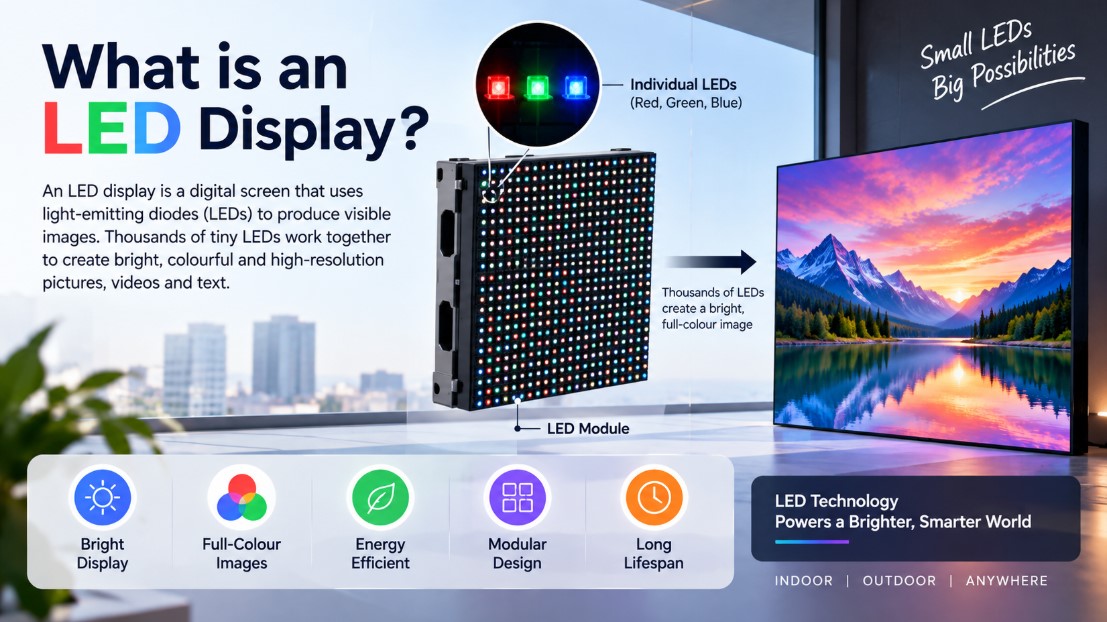
An LED display is a digital screen that uses light-emitting diodes to produce visible images. Full-colour displays generally combine red, green and blue light to create the wide range of colours needed for photographs, graphics and video.
The development of efficient blue LEDs was particularly important because combining red, green and blue made practical full-colour LED display systems possible.
Today’s systems are normally built from individual modules or cabinets. Multiple cabinets can be connected to create a screen of the required dimensions.
This modular construction is one of the main advantages of an LED video wall. Instead of being restricted to the dimensions of a conventional television or monitor, businesses can create displays covering substantial sections of a wall or building.
Indoor vs Outdoor LED Displays
Although both technologies work on similar principles, an indoor LED screen and an outdoor model have different operating requirements.
| Feature | Indoor LED Display | Outdoor LED Display |
| Typical viewing distance | Short to medium | Medium to long |
| Brightness requirement | Moderate | High |
| Weather protection | Usually unnecessary | Essential |
| Typical pixel pitch | Finer | Often larger |
| Direct sunlight | Limited concern | Important consideration |
| Common locations | Shops, offices, malls, exhibitions | Buildings, stadiums, roads, events |
| Main purpose | Close-viewing content and information | Large-scale advertising and communication |
Choosing between them should therefore involve more than simply selecting the required screen dimensions.
Indoor LED Displays for Businesses and Retail
Indoor LED displays have become increasingly common in commercial environments because they provide a large digital canvas without the thick borders that can appear when conventional monitors are placed together.
A modular LED video wall can create a nearly continuous visual surface. This makes the technology particularly useful when a business wants a large screen to become part of its interior design.
Retailers can use digital displays for advertisements, promotions, product demonstrations, branding or directions. Content can be scheduled and updated without replacing physical posters every time a campaign changes.
Indoor installations are commonly found in:
- Shopping centres
- Retail stores
- Corporate offices
- Hotels
- Conference centres
- Museums
- Universities
- Airports and railway stations
- TV studios
- Entertainment venues
- Control rooms
- Showrooms
One increasingly popular application is the fine-pitch LED display.
What is a Fine-Pitch LED Display?
Pixel pitch describes the distance between neighbouring LED pixels, normally measured in millimetres. A smaller pixel pitch places pixels closer together and generally provides greater pixel density.
Fine-pitch LED screens are therefore particularly useful when viewers will stand relatively close to the display.
For example, an LED wall installed behind a reception desk needs different specifications from a huge digital billboard viewed from across a road.
Choosing the smallest possible pixel pitch is not automatically the best approach. Higher pixel density can increase the cost of the installation. The correct specification should balance viewing distance, screen dimensions, content requirements and budget.
Benefits of Indoor LED Video Walls
One of the biggest advantages of an indoor LED video wall is scalability. The modular design allows manufacturers and installers to construct displays in dimensions that would be difficult to achieve with ordinary commercial monitors.
LED installations can also be incorporated into architectural and interior-design projects.
Depending on the hardware and installation, displays may be designed around corners, columns, curved surfaces or unusually proportioned spaces. Flexible and creative LED configurations have expanded the possibilities even further.
Another benefit is content flexibility. The same screen might show advertising in the morning, promotional video later in the day and customer information when necessary.
Modern systems may also integrate with digital signage software, allowing authorised teams to schedule and manage content remotely.
Outdoor LED Displays for Advertising and Events
Outdoor LED displays have a different set of challenges.
An outdoor digital display needs enough brightness to remain readable under strong ambient light. It also requires an enclosure and installation appropriate for environmental conditions such as rain, dust, temperature changes and wind.
Outdoor LED screens are commonly installed in:
- Stadiums and sports venues
- Building façades
- Shopping districts
- Transport hubs
- Concert and festival venues
- Public squares
- Exhibition areas
- Roadside advertising locations
- Commercial developments
Large outdoor LED displays can be used for advertising, public information, live broadcasts, event content, scores, schedules and emergency messaging.
The ability to change content digitally makes them particularly useful in locations where multiple messages need to appear throughout the day.
Outdoor LED Advertising Screens
Digital out-of-home advertising has become an important application for outdoor LED technology.
A conventional billboard normally requires the physical advertisement to be replaced when a campaign changes. A digital LED billboard can display multiple campaigns according to a predetermined schedule.
For advertisers and operators, this creates more flexibility.
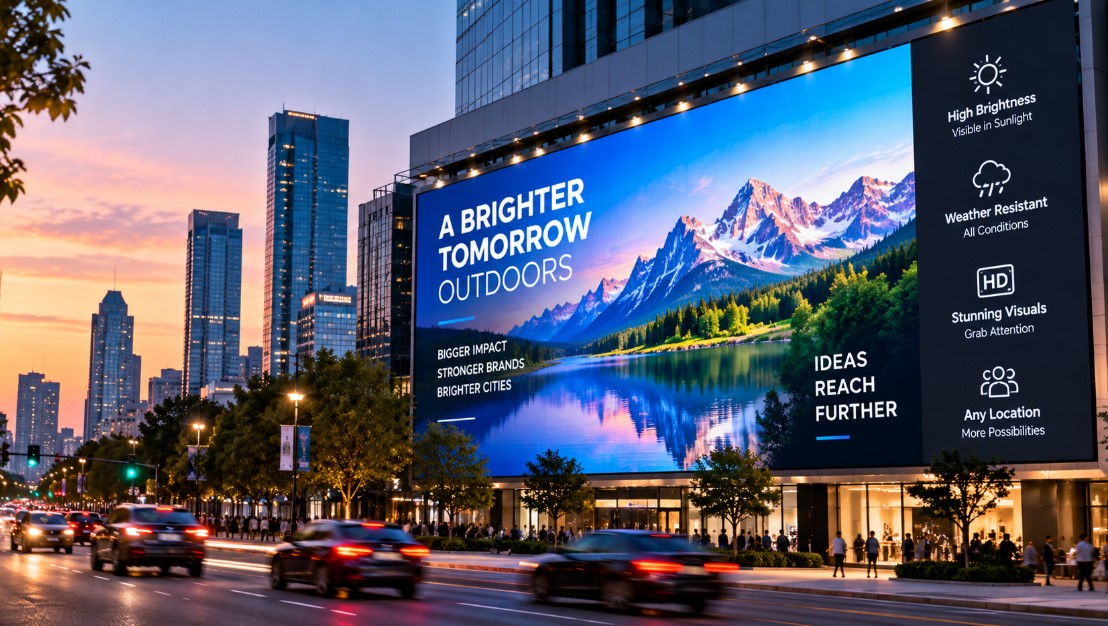
A digital billboard might display different content depending on the time of day, campaign schedule or event. However, outdoor advertising installations remain subject to local planning, safety, brightness and advertising regulations, so the technical capability of a screen does not automatically mean it can be installed in every location.
LED Screens for Events
Another important area is event LED screens.
Concerts, conferences, festivals and sporting events frequently require displays that can be seen by large audiences. LED video walls can display performers, presentations, sponsor messages, live camera feeds, graphics and event information.
Temporary installations differ from permanent outdoor displays because equipment may need to be assembled and removed quickly.
Rental LED display systems are consequently designed with repeated transportation and installation in mind. The appropriate equipment depends on whether the event is indoors or outdoors, the expected audience size, viewing distance and required screen dimensions.
Understanding LED Screen Brightness
Brightness is commonly expressed in nits.
Indoor screens generally do not require the extremely high brightness levels associated with outdoor displays because the surrounding lighting conditions are more controlled.
Outdoor installations must compete with daylight and, in some cases, direct sunlight.
More brightness is not always better. An excessively bright screen used indoors can be uncomfortable to view and may consume unnecessary electricity. Outdoor displays can also require automatic or scheduled brightness adjustment so they remain suitable as ambient light changes between daytime and nighttime.
The ideal brightness therefore depends on the environment rather than one universal specification.
Resolution and Viewing Distance
Customers often concentrate on resolution when comparing LED screens, but viewing distance is equally important.
A display designed to be viewed from several metres away does not necessarily need the same pixel density as one viewed from close range.
The content also matters.
A screen primarily showing large advertisements may have different requirements from one displaying detailed text, financial information or presentation slides.
When planning an installation, businesses should consider:
- Minimum expected viewing distance
- Overall screen dimensions
- Pixel pitch
- Content resolution
- Brightness
- Installation environment
- Expected operating hours
- Maintenance access
Evaluating these factors together usually produces a more practical specification than focusing on resolution alone.
Are LED Displays Energy Efficient?
Energy consumption is another important consideration, especially for large displays operating for many hours each day.
LED technology can provide efficient light output, but the actual electricity consumption of an LED wall varies considerably according to screen area, brightness, displayed content, hardware efficiency and operating schedule.
For this reason, claims that every LED screen automatically uses less electricity than every alternative technology should be treated carefully.
Modern systems can reduce unnecessary consumption through brightness management, efficient power supplies and scheduled operation.
Businesses comparing products should request typical and maximum power-consumption specifications rather than relying only on general efficiency claims.
How Long Does an LED Display Last?
Commercial LED systems are generally designed for extended operation, but there is no single lifespan that applies to every installation.
Manufacturers may quote very long expected operating lifetimes, sometimes reaching tens of thousands of hours. Actual performance depends on operating temperature, brightness settings, component quality, ventilation, maintenance and daily usage.
LEDs may also gradually lose brightness rather than suddenly stop operating at a predetermined number of hours.
Maintenance planning is therefore important.
Because large LED walls consist of modules, technicians can often service or replace individual components instead of replacing the entire display. Front-serviceable designs can be especially useful where there is limited access behind the screen.
Choosing the Right LED Display
The best LED screen is not necessarily the largest or the model with the finest pixel pitch.
Start with the location and intended purpose.
A luxury retail store requiring a close-viewed display may prioritise fine pixel pitch, colour reproduction and discreet installation. A stadium will prioritise visibility over much greater distances, while an outdoor billboard requires high brightness and weather resistance.
Businesses should ask potential LED display manufacturers or suppliers about:
- Pixel pitch and recommended viewing distance
- Screen brightness
- Refresh rate
- Weather protection for outdoor models
- Power consumption
- Front or rear maintenance access
- Control system
- Content-management compatibility
- Warranty
- Replacement module availability
- Installation and structural requirements
- Technical support
For large permanent installations, long-term maintenance can be just as important as the initial purchase price.
The Future of Indoor and Outdoor LED Displays
LED display technology continues to develop as manufacturers work on smaller pixel pitches, improved efficiency, higher contrast, lighter cabinets and more creative installation formats.
Transparent LED displays are opening additional possibilities for shop windows and architectural installations, while flexible and curved systems allow digital displays to become part of the physical design of a space.
Fine-pitch technology is also allowing LED walls to move into environments traditionally dominated by LCD displays, including meeting rooms, studios and premium corporate spaces.
The result is that LED screens are increasingly being considered not simply as advertising displays but as integrated digital communication systems.
Conclusion
Indoor and outdoor LED displays provide businesses with a flexible way to present advertising, information, entertainment and branded content at almost any scale.
Indoor LED video walls are particularly suited to retail spaces, offices, transport hubs, museums and entertainment venues where close viewing, seamless presentation and design flexibility are important. Outdoor LED screens focus more heavily on brightness, visibility, durability and resistance to environmental conditions.
Choosing the right system requires careful consideration of pixel pitch, viewing distance, brightness, resolution, power requirements, installation conditions and maintenance.
As LED technology continues to improve, applications are expanding beyond conventional rectangular screens. Fine-pitch, curved, flexible and transparent displays are making it possible to integrate digital content directly into retail, commercial, entertainment and architectural environments.
Check out: Why are LED Light Fixtures Important for Industrial Spaces


Top 10 Legacy Software Modernization Companies in 2026

Manikarnika Ghat in Varanasi: History, Cremation Rituals, Beliefs and Visitor Guide

How to Choose an Ergonomic Office Chair for Women That Actually Fits

Top Movies and TV Shows in the US: JustWatch September 2026 Streaming Charts

5 Best Indoor Air Quality & Mold Companies in Houston (2026)
-

 Celebrity1 month ago
Eileen Gu: Age, Parents, 2026 Olympics, Modeling Career, Height and Personal Life
-

 Tech1 month ago
18Moa – Website Directories, Online Discovery, and Safer Browsing
-

 Animals1 month ago
Understanding the American XL Bully Ban in the UK: Rules and Changes in 2026
-
 Tech2 months ago
WhatsApp Chat Theme Not Showing? How to Fix It