Tech
Top 10 Legacy Software Modernization Companies in 2026

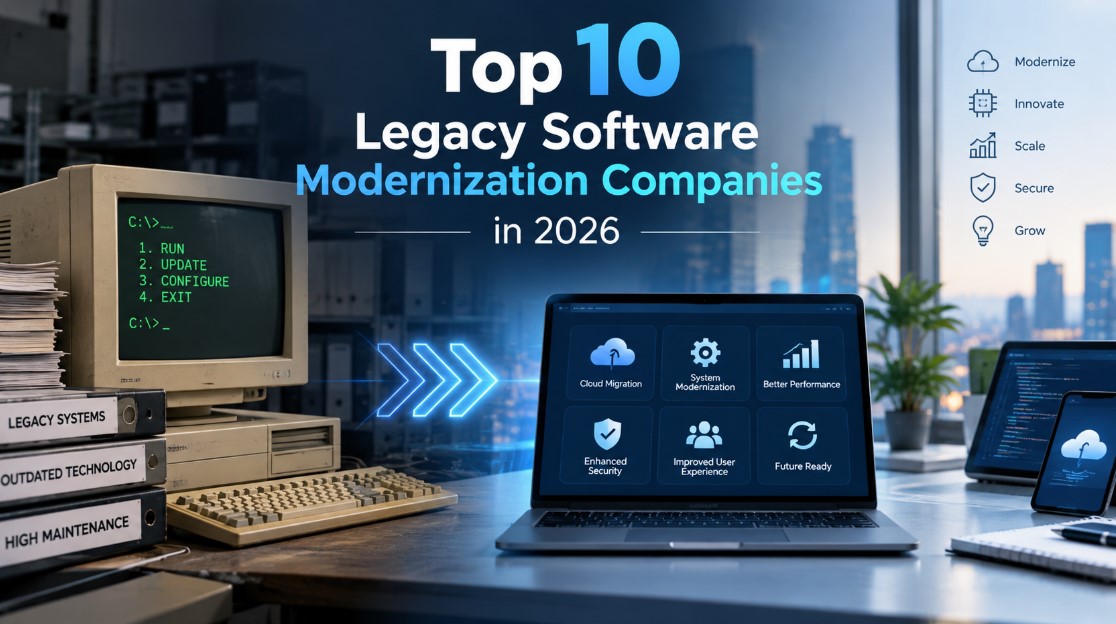
Legacy software doesn’t announce when it becomes a problem. Maintenance costs creep up. A feature that used to take a week now takes a month. The developer who actually understood the system retired two years ago. Every change surfaces a dependency nobody mapped because nobody needed to until now.
By the time modernization gets approved, the pain has been building for years. The hard part isn’t the decision — it’s finding a company that can handle what’s actually in the system without making things worse in the process.
Recode is worth a look before you start talking to anyone — a platform built specifically for finding and comparing companies across software modernization, application migration, and legacy transformation.
1. Corsac Technologies
Website: corsactech.com
Location: United States
Founded: 2007
Team size: 50-249
Legacy stacks: .NET Framework, AngularJS, ASP.NET Web Forms, Monolithic architecture, Delphi, ColdFusion, COBOL, FoxPro, VB.NET, Xamarin
Modern alternatives: .NET Core/.NET, Angular, Microservices, TypeScript, React/Vue, Flutter, Blazor/WebAssembly, Power BI/Tableau
Corsac Technologies uses an AI-driven software modernization approach to accelerate legacy system analysis, dependency discovery, business logic extraction, and risk reduction. Eighteen years of practice. Confirmed delivery in financial services, healthcare, and other regulated industries where getting something wrong isn’t just a project setback.
The AI analysis phase is where their approach differs most visibly from traditional legacy modernization. Their RAG architecture semantically indexes the codebase — finding related logic that static analysis misses, surfacing hidden patterns in code written by developers who left a decade ago, connecting components whose relationship exists in behavior rather than documentation. The Multi-Agent Swarm runs dependency mapping, complexity scoring, security detection, and business logic extraction simultaneously. Days rather than months to get actual system understanding.
What follows is standard in shape but better grounded: re-engineering to the right modern stack, behavioral parity validation at each step, canary deployments with automated rollback. The difference is that execution starts from a real picture of the system rather than an estimate of one. SOC 2 Type II, HIPAA, PCI DSS, GDPR.
Key differentiator: AI-driven legacy analysis that produces genuine system understanding before execution begins — scope based on evidence rather than estimates
2. Reliqsy
Website: reliqsy.com
Location: United States
Founded: 2014
Team size: 50-249
Legacy stacks: .NET Framework, ASP.NET Web Forms, Java, JavaScript, jQuery, AngularJS, VB.NET, monolithic architectures
Modern alternatives: .NET Core/.NET, Java, React, Angular, TypeScript, Node.js, microservices
Reliqsy combines AI with the practical expertise of modernization and migration specialists — using an AI-powered approach to analyze legacy code, extract business logic, and accelerate refactoring and modernization. Their positioning is deliberate: human-led delivery accelerated by AI, not autonomous AI with humans watching.
RAG-driven dependency analysis and hidden logic detection compress months into days. Specialized agents handle refactoring without downtime, each step validated through multiple testing layers. But the roadmap requires engineer sign-off before code generation starts. Every AI-generated change goes through Pull Request review. Rollback fires at concrete thresholds — 400ms latency or 1% error rates — automatically. A real-time dashboard tracks what’s been modernized, what’s in progress, where risk is building.
Key differentiator: AI speed with human control at every consequential decision — the combination that reduces timeline without surrendering governance
3. Zoolatech
Website: zoolatech.com
Location: United States, Europe, Latin America, MENA
Founded: 2017
Team size: 600+
Hourly rate: $50-$99/hr
Legacy stacks: Ruby on Rails, Java monoliths, C++, Angular, JavaScript, ERB, tightly coupled architectures
Modern alternatives: AWS, Azure, Kubernetes, microservices, React, TypeScript, Spring Boot, Kafka, REST APIs
Zoolatech assesses before committing — technical debt, system dependencies, the actual state of the codebase — before selecting a modernization path. Targeted refactoring. Framework upgrades. Cloud migration. Platform re-engineering. Monolith-to-microservices. The assessment determines which, rather than the engagement model determining it before the assessment happens. Their phased approach spans retail, healthcare, fintech, telecom, logistics, energy, and enterprise software.
Key differentiator: Assessment-first path selection — the modernization approach gets determined by what’s in the system, not preset by the vendor
4. DXC Technology
Website: dxc.com
Location: United States (global)
Founded: 2017
Team size: 10,000+
Legacy stacks: ASP.NET Web Forms, Monolithic architecture, JavaScript, jQuery, VB.NET
DXC works where legacy complexity is highest and disruption tolerance is lowest — aerospace, defense, energy infrastructure, financial services at scale. Their AI-backed methodology targets operational simplification with the security posture those sectors require. When a legacy portfolio spans dozens of interconnected systems nobody has a complete map of, they have the delivery infrastructure to handle it.
Key differentiator: Delivery scale and domain depth for the highest-stakes regulated industries
5. Smartbridge
Website: smartbridge.com
Location: United States
Founded: 2003
Team size: 50-249
Hourly rate: $150-$199/hr
Modern alternatives: AWS, Azure, Docker, Python, Java, Node.js, .NET Core
Smartbridge’s practice spans data and analytics, intelligent automation, and AI implementation alongside modernization — which matters when the legacy system is blocking something else leadership has already committed to. A data strategy. An automation initiative. A product capability that requires infrastructure the old system can’t support. They assess the existing application before recommending anything rather than defaulting to full rewrite.
Key differentiator: Modernization positioned inside a broader data and automation practice — the code is the starting point, not the scope
6. The Smyth Group
Website: thesmythgroup.com
Location: United States
Founded: 2005
Team size: 10-49
Hourly rate: $150-$199/hr
Modern alternatives: AWS, Azure, Docker, Python, Java, Node.js, .NET Core, Microservices
The Smyth Group sets defined deliverables at each phase — strategy, development, scaling — with clients tracking actual progress rather than receiving periodic status updates. They work with clients to surface fundamental issues before prescribing anything. For organizations that have sat through modernization programs where months passed without anything tangible, that structure is substantively different from how most engagements run.
Key differentiator: Defined deliverables at every phase — progress that’s visible to clients rather than reported by vendors
7. Devox Software
Website: devoxsoftware.com
Location: USA, Poland, Ukraine
Founded: 2018
Team size: 50-249
Hourly rate: $50-$99/hr
Modern alternatives: Angular, .NET, Java, Python, React JS, Vue JS, Node JS
Devox built their own tool — the AI Solution Accelerator™ — specifically to reduce development time and cut inefficiencies through automation rather than headcount. Security vulnerabilities, vendor lock-in, workflow bottlenecks. Their 95% customer satisfaction rate is notable in a market where disappointed clients are common and rarely quiet about it.
Key differentiator: Proprietary AI Solution Accelerator™ — purpose-built tooling, not generic AI applied to modernization
8. Leobit
Website: leobit.com
Location: Ukraine, Poland
Founded: 2014
Team size: 50-249
Hourly rate: $25-$49/hr
Legacy stacks: WCF, WinForms, VB.NET, Delphi
Modern alternatives: .NET Core, Angular, microservices, ASP.NET, C#, Azure, Blazor, React, Vue, TypeScript
Leobit’s depth in WCF, WinForms, VB.NET, and Delphi — stacks that many vendors claim to handle without actually knowing them — changes what’s possible in the assessment phase. They act as technology advisors from inception through maintenance and support rather than handing off after go-live. Their own design studio handles UI/UX alongside the modernization work.
Key differentiator: Genuine WCF, WinForms, and Delphi expertise — assessment accuracy on stacks most vendors approximate
9. Euvic
Website: euvic.com
Location: Poland, Germany, USA, 4+ countries
Founded: 2005
Team size: 1,000-9,999
Hourly rate: $50-$99/hr
Modern alternatives: AWS, Azure, Docker, Python, Java, Node.js, .NET Core, Microservices
Euvic’s 20+ office locations and team augmentation model make them practical for programs that need to scale capacity up or down as work progresses. Build and modernize. Optimize operations through cloud. Integrate into unified platforms. Implement AI alongside modernization. For organizations that need to supplement an internal team for specific phases without separate hiring processes, their augmentation model handles that directly.
Key differentiator: Team augmentation alongside modernization — capacity adjusts to the program rather than the program adjusting to vendor capacity
10. Innowise
Website: innowise.com
Location: Poland, Ukraine, Germany, Lithuania
Founded: 2007
Team size: 1,000-9,999
Hourly rate: $50-$99/hr
Modern alternatives: AWS, Microsoft Azure, Google Cloud, Kubernetes, Docker
Innowise’s full-cycle model means the team that learns the system during consulting supports it through modernization and post-launch. Institutional knowledge doesn’t get handed off between teams at each project stage. Their focus: removing old vendor dependencies, excessive maintenance costs, trapped data, inefficient workflows. The problems that accumulate in legacy systems over decades rather than the ones that make for good case studies.
Key differentiator: Full-cycle continuity — the team that understands the system from discovery maintains it after go-live
How to Choose Legacy Software Modernization Companies
Require system understanding before execution starts
Programs that go badly almost always share one root cause: scope was wrong because nobody understood the system before the project began. Surprises surface mid-execution when course corrections are expensive and visible. Companies that invest in rigorous analysis before committing to an approach — through AI-assisted tooling or structured manual assessment — consistently produce better outcomes than those that start executing based on assumptions.
Ask about parallel operation during transition
Full cutover in a single phase carries high operational risk for most legacy systems. Ask specifically how companies manage parallel operation of legacy and modern environments during transition — how long that phase runs, what triggers cutover, and what triggers rollback. The answers reveal whether you’re looking at a company that has run real modernization programs or one proposing an approach that sounds reasonable on paper.
Check compliance throughout delivery, not at the end
Legacy systems in regulated industries carry compliance requirements that apply to the modernization process itself, not just the result. Compliance validation at the end of a program means findings require expensive rework. Verify that compliance requirements are embedded throughout delivery from the start.
Look at legacy language expertise specifically
Ask which team members will work on your engagement and what direct experience they have with your specific legacy stack — not the modern target stack, the legacy one. COBOL, Delphi, WCF, VB.NET — companies that know these from the inside assess systems more accurately and encounter fewer avoidable surprises mid-program.
Ask about post-modernization support
Legacy systems don’t stop requiring attention after go-live. Ask specifically whether the team that modernizes the system supports it afterward or hands off to a separate team. The handoff is where institutional knowledge about how the system actually works gets lost — which creates the same problem the modernization was supposed to solve.
For a broader view of legacy software modernization companies, Recode lets you search and compare vendors across software modernization, application migration, and legacy transformation.
Check out: Information About FoxTrax Software: Augmented Reality in Sports



Eileen Gu: Age, Parents, 2026 Olympics, Modeling Career, Height and Personal Life

18Moa – Website Directories, Online Discovery, and Safer Browsing

Understanding the American XL Bully Ban in the UK: Rules and Changes in 2026

Best UI/UX Design Agencies for Enterprise Products in 2026

Broken Keyboard Grok Answer: How to Understand and Solve the Coding Problem
-
 Celebrity4 weeks ago
Eileen Gu: Age, Parents, 2026 Olympics, Modeling Career, Height and Personal Life
-
 Tech4 weeks ago
18Moa – Website Directories, Online Discovery, and Safer Browsing
-
 Animals4 weeks ago
Understanding the American XL Bully Ban in the UK: Rules and Changes in 2026
-

 Tech2 months ago
WhatsApp Chat Theme Not Showing? How to Fix It