
Tech
Best Site Selection Software for Retail Expansion: A Data-Driven Guide

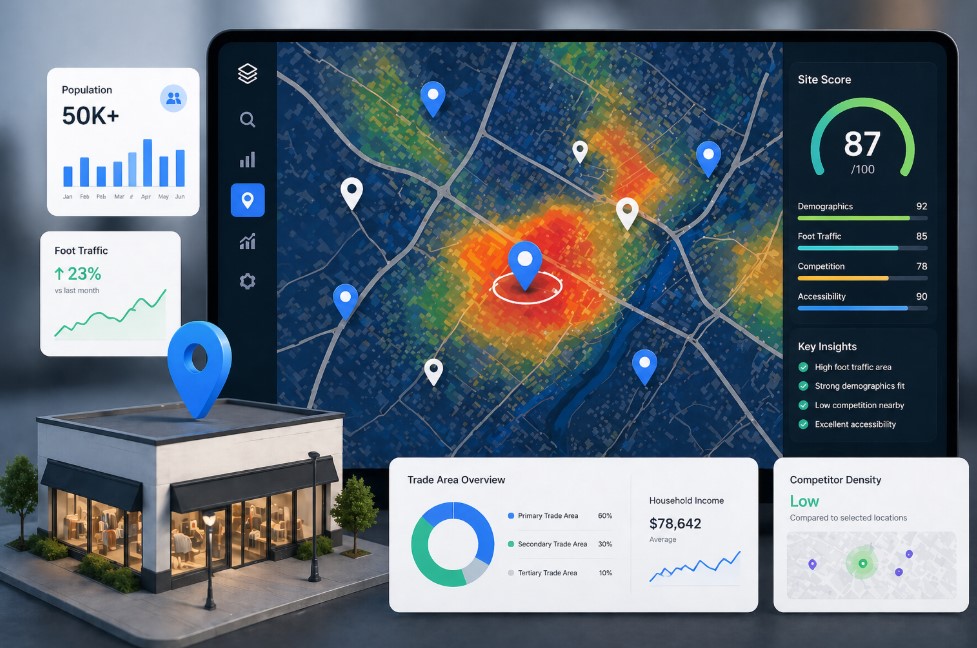
Opening a store in the wrong location costs $100,000 to $500,000 per location—and happens more often than you’d think. According to the National Retail Federation, nearly 30% of new retail locations underperform expectations due to poor site selection, making location intelligence the single most critical success factor for retail expansion.
The good news? The best site selection software transforms this guesswork into data-driven certainty. Whether you’re a franchisee opening your fifth location or a regional chain expanding into new markets, advanced site selection tools powered by AI and real foot traffic analytics can predict store performance with 85–92% accuracy. In this guide, we’ll explore how to choose the right retail site selection software and maximize your expansion ROI.
What Is Site Selection Software and Why Does It Matter?
Defining Advanced Site Selection Tools
Site selection software is a category of location intelligence platforms that combine foot traffic analytics, demographic data, competitive mapping, and predictive modeling to help retailers identify optimal store locations. These tools use real-world data—not historical averages—to give you a clear picture of where your customers are, where they’re moving, and which locations will drive sustainable profitability.
The Cost of Poor Site Selection
Consider this: a single poorly located store costs $300K in build-out, $150K in initial inventory, and $2,000–$5,000 monthly in overhead. If that location underperforms, you’re looking at annual losses of $100K–$300K. Over a five-year lease, that’s $500K–$1.5M in pure waste. The best site selection software pays for itself many times over by preventing just one or two bad locations.
Key Features of the Best Retail Site Selection Software
Not all site selection platforms are created equal. Here’s what separates best-in-class retail site selection software from the rest:
1. Real Foot Traffic Data
The foundation of any advanced site selection tool is accurate, real-time foot traffic analytics. This means mobile location data from smartphone signals, app partnerships, and Wi-Fi hotspots—not guesswork. You should be able to see hourly visitor patterns, demographic breakdowns, and dwell time to understand whether a location attracts your target customer.
2. Cannibalization Risk Modeling
If you’re expanding a multi-unit network, cannibalization—where a new store steals sales from existing locations—can devastate profitability. The best GIS site selection software includes predictive models that show how much revenue a new store will capture from your existing portfolio, allowing you to optimize spacing and maximize network-wide performance.
3. Revenue Forecasting and P&L Modeling
Beyond foot traffic, top-tier AI site selection tools integrate revenue predictions tied to your specific business model. Some platforms now offer P&L projections that show estimated sales, labor costs, and break-even timelines based on location-specific variables. This transforms foot traffic data into actionable financial forecasts.
4. Competitive Mapping and White Space Identification
Understanding your competitive landscape is essential. Best-in-class retail site selection software shows competitor store locations, their traffic patterns, and identifies ‘white space’ opportunities—underserved markets where customer demand exists but supply is limited.
5. GIS Mapping and Trade Area Analysis
Dynamic GIS (Geographic Information Systems) mapping lets you visualize trade areas, demographic clusters, and accessibility patterns. The best site selection software integrates drive-time analysis, public transit accessibility, and neighborhood demographics to build a 360-degree view of each location’s viability.
How to Choose the Right Site Selection Software: A Decision Framework
Evaluating GIS site selection software requires understanding your expansion strategy. Use this framework to narrow your options:
Step 1: Define Your Expansion Velocity
Are you opening 5 stores this year, 50, or 500? Fast-growing franchisees need rapid deployment and intuitive interfaces. Slower, more deliberate expansions benefit from deeper competitive analysis. MapZot.AI, for example, is optimized for mid-market operators expanding 5–50 locations annually, with implementation timelines measured in days rather than months.
Step 2: Assess Your Budget Reality
Advanced site selection tools range from $5,000 to $250,000+ annually. Define your realistic budget and don’t let feature creep push you toward expensive enterprise solutions if a mid-market alternative delivers your core requirements. ROI should drive your investment, not prestige.
Step 3: Evaluate Data Quality and Accuracy
Ask vendors for validation case studies showing foot traffic correlation to actual sales. Industry leaders typically achieve 85–92% accuracy. This matters: a 7% forecast error on a $1M location is $70,000 in unexpected loss.
Step 4: Test with Your Real Data
Most vendors offer free trials. Use them to analyze 2–3 locations you’re actually considering. Compare the software’s recommendations against your market intuition. If the data feels wrong, it’s not the right tool for your business.
Best Site Selection Software for Different Retail Segments
The right tool depends on your retail category:
For QSR and Fast Casual Franchises
Drive-time accessibility, foot traffic density, and nearby office/residential density are critical. Look for platforms with real-time foot traffic data and strong drive-time analysis. MapZot.AI’s focus on hourly visitor patterns and cannibalization prevention is particularly suited to multi-unit QSR expansion.
For Retail and Specialty Stores
Trade area depth, demographic precision, and mall/center anchoring matter more than sheer foot traffic. You need GIS site selection software with strong demographic segmentation and anchor-store analysis.
For Healthcare and Professional Services
Insurance coverage maps, income distribution, and aging demographics take priority. Look for platforms with health/demographic specialization and proximity analysis tools.
Real-World Impact: What You Can Expect
When retailers deploy the best site selection software systematically, the numbers speak for themselves:
- Reduced underperforming locations: From 25–30% to 5–10% of new stores
- Faster site identification: From 6 months to 4–6 weeks
- Higher per-unit volumes: Average 12–18% uplift in Year 1 comparable stores
- Lower implementation costs: Eliminating 2–3 poor locations annually saves $200K–$600K
These gains compound quickly. A franchise network opening 20 stores annually could realize $4M–$12M in incremental value over three years simply by eliminating location selection errors.
Implementation Best Practices
1. Start with Historical Validation
Before committing to new locations, analyze your existing portfolio through your chosen platform. Compare its recommendations against your actual store performance. This validates the tool’s accuracy for your specific business model and builds internal confidence.
2. Integrate with Your Decision Process
Don’t treat site selection software as a black box. Use it as one input in a multi-factor decision process that includes relationship partnerships, real estate availability, and landlord quality. The best advanced site selection tools inform decisions; they don’t replace human judgment.
3. Track Performance Against Predictions
After opening new locations, continuously compare actual performance to the software’s forecast. This feedback loop helps you refine parameters over time and ensures you’re extracting maximum value from your investment.
Conclusion: The Time to Invest in Site Selection Software Is Now
Retail expansion without best-in-class site selection software is essentially gambling. The cost of poor decisions—both in direct losses and in missed opportunities—far outweighs the investment in advanced AI site selection tools or GIS site selection software.
Whether you’re a single-unit operator exploring your next location or a multi-unit network planning your next 50 stores, the right retail site selection software is no longer a luxury—it’s a competitive necessity. The platforms available today combine real foot traffic data, predictive analytics, and intuitive interfaces that would have cost millions just five years ago.
Take action today: Request a demo from two or three vendors, analyze your planned locations, and compare the insights. In 30 days, you’ll have more clarity on your next location decision than you would in six months of traditional analysis. Your next profitable location is just one data-driven decision away.
Ready to Eliminate Location Risk? Explore how the best site selection software is transforming retail expansion strategies. [Learn more about advanced site selection tools designed for franchisees and regional operators]



Eileen Gu: Age, Parents, 2026 Olympics, Modeling Career, Height and Personal Life

18Moa – Website Directories, Online Discovery, and Safer Browsing

Understanding the American XL Bully Ban in the UK: Rules and Changes in 2026

Best UI/UX Design Agencies for Enterprise Products in 2026

Broken Keyboard Grok Answer: How to Understand and Solve the Coding Problem
-
 Celebrity3 weeks ago
Eileen Gu: Age, Parents, 2026 Olympics, Modeling Career, Height and Personal Life
-
 Tech3 weeks ago
18Moa – Website Directories, Online Discovery, and Safer Browsing
-
 Animals3 weeks ago
Understanding the American XL Bully Ban in the UK: Rules and Changes in 2026
-

 Finance2 months ago
Loan Officer’s Guide: How to Calculate Self-Employed Income?