
Tech
The Hidden Infrastructure Behind a Dynamic QR Code


The image does not change. The system around it does.
A QR code printed on a poster looks permanent. Once the ink is on paper, the pattern of black and white modules cannot be rewritten. Yet many QR products promise something that sounds contradictory: change the destination later without changing the code.
That promise is real, but the QR image is not what becomes editable. The trick is architectural. A dynamic QR code usually contains the address of an intermediate redirect service. That service receives the scan and decides where to send the visitor next. Change the rule on the server, and the same printed pattern can lead somewhere new.
This small layer of indirection turns a simple barcode into a software product. It adds flexibility and measurement, but it also adds infrastructure, failure modes, privacy questions and long-term dependencies that are easy to miss when the product is presented as nothing more than an “editable QR code.”
A static QR code is brutally simple
In the simplest case, the QR code contains the final destination itself. If the destination is https://example.com/menu, that URL is encoded directly into the pattern. A phone scans the code, decodes the URL and opens it. There is no QR platform in the middle.
That simplicity has important consequences. There is one less service that can fail, one less redirect to add latency, and one less company observing the request. If the destination remains valid, the printed QR can keep working even if the service used to generate the image disappears entirely.
The weakness is equally clear: the destination is baked into the image. If the URL changes after ten thousand menus, labels or flyers have been printed, the QR cannot be updated. The physical asset and the digital destination are tightly coupled.
Dynamic QR codes move the changeable part to the server
A dynamic QR breaks that coupling. Instead of encoding the final page, it encodes a stable short URL controlled by a redirect service. The database behind that URL stores the current destination.
A scan might therefore follow a path like this:
| 1 | The phone decodes a stable URL from the QR image. |
| 2 | The redirect server receives the request. |
| 3 | The service looks up the current destination for that code. |
| 4 | The server returns an HTTP redirect. |
| 5 | The phone opens the destination. |
When the owner edits the destination, the QR image remains untouched. Only the database record changes. The next scan reaches the same redirect URL, but the server now points somewhere else.
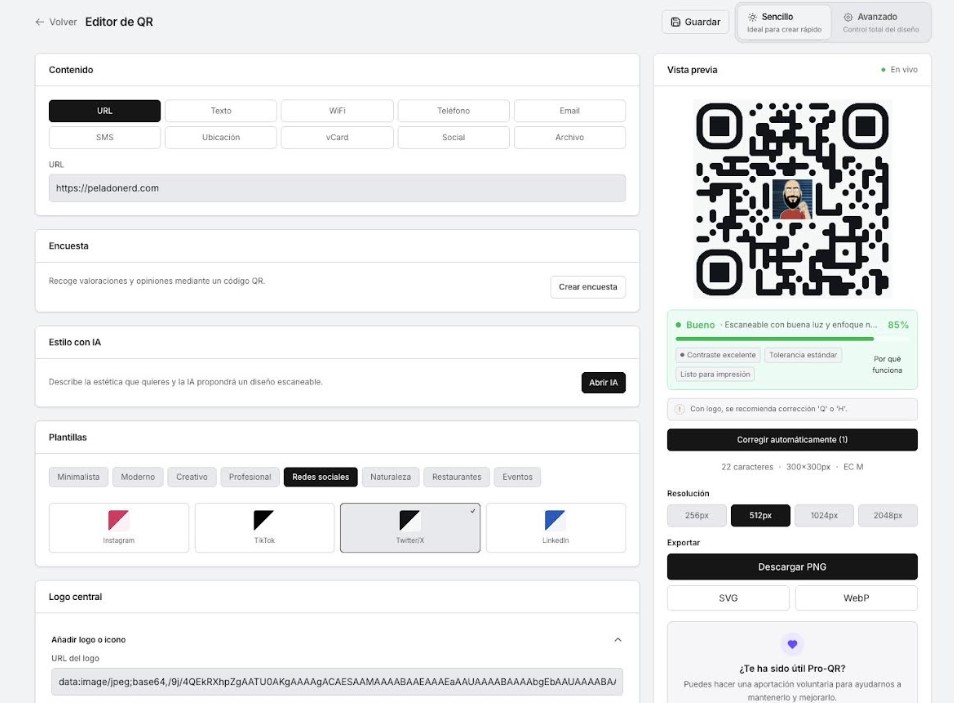
ProQR’s editor separates the editable destination from the QR image shown in the live preview.
That is the core of “dynamic” QR technology. The dynamism does not live in the code. It lives in the redirect infrastructure.
The same redirect that enables editing also enables analytics
Once every scan passes through a server, the service can record an event before redirecting the visitor. At a minimum, that can include a timestamp and the specific QR identifier. Depending on the implementation, the server may also infer coarse location from an IP address and classify information such as device type, operating system or browser from the request headers.
For a business, this can make printed media measurable in a way that ordinary paper is not. A restaurant can compare scans from two table displays. An event organizer can see whether a poster is still generating traffic. A retailer can measure whether a QR placed on packaging is being used after the product leaves the store.
But scan analytics should not be confused with perfect attribution. A scan does not automatically reveal who the person is, why they scanned, whether they completed a purchase or whether the apparent location is exact. VPNs, mobile networks, privacy protections, and shared connections can all reduce precision. Good QR analytics are useful signals, not omniscient tracking.

ProQR’s QR Studio surfaces scan count and code status alongside management controls.
Flexibility creates a new dependency
The biggest trade-off is reliability. A static QR pointing directly to a website depends mainly on the destination website and the network connection. A dynamic QR depends on those things plus the redirect layer.
If the redirect domain expires, the redirect service is down, the database lookup fails, the code is accidentally disabled or a routing rule is misconfigured, a perfectly printed QR can stop working. The paper has not changed. The infrastructure behind it has.
This matters because QR codes are often placed on physical objects that outlive software plans. A poster may be temporary, but packaging, signage, product manuals, museum labels or business cards can remain in circulation for years. A dynamic QR therefore creates a long-term operational promise: the redirect URL must keep resolving for as long as the printed asset matters.
That changes how a QR platform should be judged. Uptime, domain continuity, redirect speed, exportability and what happens if an account is closed can matter more than the number of design templates in the editor.
Check out: How to Scan QR Codes in Snapseed in 2026
Tracking paths must be architecturally consistent
There is another less visible problem: analytics are only trustworthy if every relevant redirect path is instrumented consistently. If one route logs the scan and another valid route reaches the destination without passing through the same tracking logic, the dashboard can undercount real usage.
This is the kind of issue that is easy to miss in development because the QR still appears to “work.” The user reaches the right destination, so the visible experience looks correct, while the measurement layer is incomplete. Redirect products need tests for both outcomes: did the visitor arrive, and did the event pipeline record what it was supposed to record?
Building ProQR reinforced this distinction for me. A dynamic QR is not one feature. It is a chain of small systems that have to agree: code generation, routing, destination storage, validation, event collection, analytics and the final redirect. A failure in any one layer can produce a product that looks correct from one angle and is wrong from another.
Privacy is a product decision, not a footnote
The same request data that makes analytics useful also creates responsibility. A QR service should be clear about what it records, what it derives, how long it keeps the data and what it does not know.
There is a strong temptation to turn a simple scan counter into increasingly detailed profiling because more dashboard fields can look like more value. That is not always true. More data creates more storage, more compliance work, more security exposure and more opportunities to mislead users about precision.
For many use cases, aggregate information is enough: number of scans, broad device categories and coarse geographic trends. The right question is not “what can we collect?” but “what information actually improves the decision the user is trying to make?”
When static is the better engineering choice
Dynamic QR codes are often sold as an upgrade, but that framing is too simplistic. Static codes are better when the destination is genuinely permanent and the owner values independence from an intermediary service.
A static QR can be the sensible choice for a canonical company homepage, a public document with a stable URL, an open standard, a permanent contact page or any context where scan analytics and destination editing add little value. Fewer moving parts can be a feature.
Static also has an important longevity advantage: the QR remains interpretable without the original generator. The code is the destination, not a pointer to a service that must continue operating.
When dynamic is worth the extra machinery
Dynamic becomes compelling when the physical object is expensive or difficult to replace while the digital destination is likely to change. Printed menus, product packaging, event signage, property listings, educational material, campaign posters and recurring promotions are obvious examples.
It is also useful when scan measurement itself affects decisions. If a team needs to compare placements, understand usage over time or retire a campaign without destroying the printed asset, the redirect layer is doing real work.
The key is that editability and analytics are not free capabilities in an engineering sense. They are services supplied continuously after the QR has been generated. A user choosing dynamic is choosing an ongoing infrastructure relationship, even if the interface makes the decision feel as simple as ticking a box.
The best QR product is not the one with the longest feature list
Working on ProQR has made me more skeptical of feature count as a measure of product quality. QR generation is already a solved technical primitive. The harder product questions begin after generation: Will the link still work later? Can the destination be changed safely? Are scan numbers trustworthy? Is the privacy model understandable? Can the user export what they need? What happens when something fails?
A good static QR tool should make permanence and simplicity obvious. A good dynamic QR tool should make the infrastructure contract equally obvious. Users should know that they are gaining control and measurement in exchange for an additional dependency.
That trade-off is not a flaw. It is the architecture. The mistake is hiding it behind the idea that one QR code is simply “more advanced” than another.
A fixed image can sit on top of a changing system
The most interesting thing about a dynamic QR code is that nothing dynamic happens to the QR itself. The printed object is immutable. All the flexibility comes from moving uncertainty into software: a stable redirect URL, a mutable destination, a database, an event pipeline and a service expected to keep running.
That pattern appears far beyond QR codes. Much of modern software works by inserting a controllable layer between a fixed interface and a changing backend. The layer creates leverage, but it also becomes infrastructure that must be operated responsibly.
So the useful question is not whether dynamic QR codes are better than static ones. It is whether the value of changing and measuring a destination is worth the additional system that has to exist between the scan and the page. Sometimes the answer is clearly yes. Sometimes the simplest QR is still the better design.
Disclosure
The author is the creator of ProQR, a web-based tool for creating static and dynamic QR codes. ProQR is referenced here only where first-hand product development experience is relevant to the topic.



Eileen Gu: Age, Parents, 2026 Olympics, Modeling Career, Height and Personal Life

18Moa – Website Directories, Online Discovery, and Safer Browsing

Understanding the American XL Bully Ban in the UK: Rules and Changes in 2026

Best UI/UX Design Agencies for Enterprise Products in 2026

Broken Keyboard Grok Answer: How to Understand and Solve the Coding Problem
-
 Celebrity4 weeks ago
Eileen Gu: Age, Parents, 2026 Olympics, Modeling Career, Height and Personal Life
-
 Tech4 weeks ago
18Moa – Website Directories, Online Discovery, and Safer Browsing
-
 Animals4 weeks ago
Understanding the American XL Bully Ban in the UK: Rules and Changes in 2026
-
 Tech2 months ago
WhatsApp Chat Theme Not Showing? How to Fix It