
Digital Marketing
High-Volume vs Low-Competition Keywords: SEO Guide
Learn how to balance high-volume and low-competition keywords, assess search intent, and choose SEO opportunities that bring relevant traffic.


Keyword research is not only about finding the biggest monthly search number. A phrase can attract a large audience and still be a poor starting point if the search results are dominated by strong, highly relevant pages. At the same time, a phrase with lower demand can bring valuable visitors when it closely matches what a business offers and when the current results leave room for a better answer.
The useful goal is to balance demand, competition, search intent, and business value. This guide explains how high-volume and low-competition search terms differ, how to evaluate them, and how to build a content plan that supports steady organic growth.
Quick answer
High-volume terms are searched frequently, so they may offer greater traffic potential. They often have more competitors and broader intent. Low-competition terms are generally easier to target because fewer strong, relevant pages compete for the same query. The best opportunities are not always the highest-volume phrases or the lowest-difficulty phrases. They are the queries your site can answer better than the current results, for an audience that matters to your goals.
What search volume means
Search volume is an estimate of how often people search for a word or phrase during a given month. Research tools calculate it from their own data sources and models, so no figure should be treated as an exact count. It is best used as a comparison tool: a phrase with an estimated 5,000 monthly searches normally has more potential reach than one estimated at 50, but the final traffic can be very different.
Seasonality, location, language, device type, and changing search behaviour all affect demand. A topic can rise after a product launch, a news event, or a holiday season. Before creating a page, check whether the demand trend is stable, growing, or temporary. Search Console can later show the actual queries that bring impressions and clicks to your own site, which is more useful than a tool estimate alone.
What competition means for a search term
Competition is often shown as a difficulty score inside SEO tools. That score can be helpful, but each platform uses its own method. It is an estimate, not a rule used by Google. A more useful manual check is to search the phrase and study the results page. Look at the type of content ranking, the authority and relevance of those pages, and whether the current results answer the query fully.
A phrase may look difficult because strong websites rank for it. Another phrase can look easy in a tool but still be hard if the search intent is unclear or the results include pages that closely match a local or commercial need. Google explains that its systems use many signals to return useful, relevant results, so one metric cannot predict performance on its own. Google’s ranking-systems guide is a helpful reminder to evaluate the page and the query, not only a score.
| Factor | High-demand phrase | Lower-competition phrase |
|---|---|---|
| Audience size | Often broader | Usually smaller but more specific |
| Ranking effort | Can require strong authority and comprehensive content | May be more achievable for a focused page |
| Search intent | Can be mixed or unclear | Often clearer because the query is longer or more detailed |
| Best use | Core guides, category pages, and long-term authority building | Supporting articles, service pages, FAQs, and early wins |
Why high-volume terms are still important
Popular queries help you understand the main subjects your audience cares about. They can inform pillar pages, major service pages, category pages, and long-term editorial planning. A business may not rank for a broad phrase immediately, but a well-built resource can improve over time as it gains useful links, user engagement, and supporting content.
For example, a general phrase such as “email marketing” may be too broad for a new site to target with one short page. It can still be a valuable theme. The site could build a detailed main guide and then publish related pages about welcome emails, subject-line testing, list growth, and campaign reporting. This creates a useful structure for readers and gives search engines clear topical connections.
High demand does not automatically mean high conversion. Someone searching a broad definition may be learning, while someone searching “email marketing agency for ecommerce” may be closer to choosing a service. Both queries can have value, but they require different page types and calls to action.
Why lower-competition opportunities matter
Less competitive queries can bring early, relevant traffic to a newer or smaller website. They are often longer, more specific searches that show a clear need. A reader looking for “how to choose keywords for guest posts” is likely to want practical steps, while someone searching “keywords” may be looking for almost anything.
Specific queries also make it easier to create a complete answer. You can cover the exact problem, examples, process, common mistakes, and next step on one page. This is valuable for AEO and GEO because clear questions, direct answers, descriptive headings, and original examples make a page easier to understand for both people and search systems.
For a related example, Shifted Magazine’s local marketing agency guide targets a more focused business need than a broad page about marketing. Specific intent gives the reader a clearer reason to visit and makes the content easier to shape around a real decision.
How to find a balanced opportunity
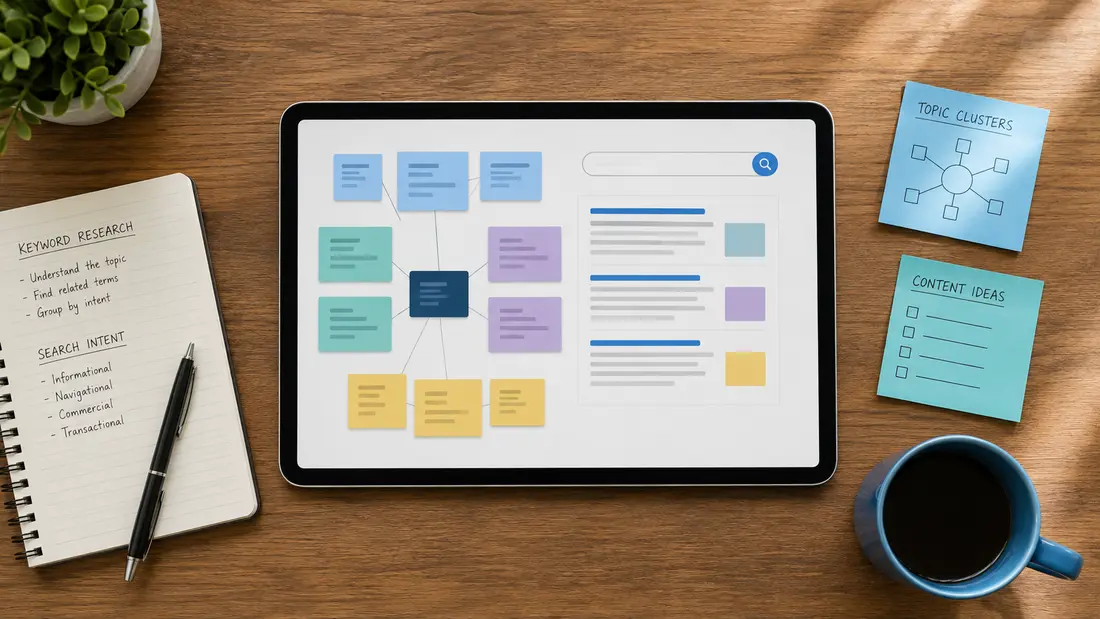
Start with topics, not a random list of phrases. Write down the services, products, questions, and problems that matter to your audience. Then use Google Search, Search Console, and a research tool to discover the language people use. Look for patterns in autocomplete suggestions, related searches, People Also Ask questions, and the words appearing in your existing performance data.
- Choose a core topic that relates directly to your site or business.
- Collect broad phrases and more specific variations around that topic.
- Group them by the same search intent instead of making one page for every minor variation.
- Review the top results manually. Note content format, depth, freshness, and gaps.
- Prioritise phrases where you can create a clearer, more useful answer.
- Map each group to one page type: guide, service page, product page, comparison, or FAQ.
Do not build several near-duplicate pages for terms that mean the same thing. That can create thin content and make it difficult to decide which page should rank. One strong page with natural related language is usually more useful than a set of weak pages that only change word order.
Check search intent before writing
Search intent is the reason behind a query. Common types are informational, navigational, commercial, and transactional. The results page usually tells you what people expect. If the first results are tutorials, a sales page may not satisfy the query. If the first results are product categories or comparison pages, a basic definition may be too limited.
Open several results and look for common elements. Do they use a list, a calculator, a comparison table, pricing, product filters, or an explanation? You do not need to copy their format. Instead, use the pattern to understand the need and improve on it with accurate information, clearer structure, and a real point of view.
| Intent | Example query type | Useful page approach |
|---|---|---|
| Informational | How to research search terms | Step-by-step guide with definitions and examples |
| Commercial | Best keyword research tools | Comparison with transparent criteria |
| Transactional | Keyword research service | Clear service page with scope, proof, and contact path |
| Navigational | Specific tool or brand name | Official or clearly identified brand resource |
Create pages that deserve to rank
Query selection only gives a page a direction. It does not replace good content. Google recommends helpful, reliable, people-first material that uses the words people use to find the content in prominent, descriptive places. That includes the title, main heading, relevant subheadings, image alt text, and natural anchor text. It does not mean repeating a phrase until the page sounds unnatural.
Give the reader a direct answer near the start. Then add the detail needed to complete the task: process, examples, limits, tools, and practical next steps. Show who the content is for and when the advice may not apply. Use internal links where they help the reader continue. For instance, an article about content-led ecommerce growth can naturally connect to our guide on AI UGC videos for ecommerce marketing.

Measure results and improve the plan
After publishing, give the page time to be crawled and indexed. Then use Search Console to review impressions, clicks, average position, and the queries that trigger the page. Look for phrases where the page appears but does not get clicks. A clearer title, improved description, stronger answer near the top, or better match to the intent may help.
Also look for relevant queries that the page already receives but does not cover well. Add a useful section only when it improves the reader’s experience. Do not add unrelated terms just because a tool reports volume. Your goal is a page that answers a real question fully, not a page with the longest list of phrases.
Common mistakes to avoid
- Choosing a topic only because a tool shows high volume.
- Treating a difficulty score as a guaranteed ranking forecast.
- Ignoring the pages already ranking and the intent they satisfy.
- Creating duplicate pages for very similar phrases.
- Repeating the same phrase too often instead of writing naturally for the reader.
- Publishing without reviewing Search Console data afterward.
Final takeaway
High-volume and low-competition phrases work best together. Broad topics can guide your long-term authority plan, while focused opportunities can attract relevant visitors and build momentum sooner. Evaluate the query, the results page, your ability to provide a better answer, and the value of the visitor after they arrive. This balanced approach creates content that is useful to readers and durable in search.
Editorial note: Search estimates and results pages change over time. Review current performance and official search guidance before making important SEO decisions.



Eileen Gu: Age, Parents, 2026 Olympics, Modeling Career, Height and Personal Life

18Moa – Website Directories, Online Discovery, and Safer Browsing

Understanding the American XL Bully Ban in the UK: Rules and Changes in 2026

Is $48 an Hour Good in Austin? Salary, Living Costs, and What It Means in 2026

Kerry Earnhardt: Career, NASCAR Record, Age and the Earnhardt Racing Family
-
 Celebrity3 weeks ago
Eileen Gu: Age, Parents, 2026 Olympics, Modeling Career, Height and Personal Life
-
 Tech3 weeks ago
18Moa – Website Directories, Online Discovery, and Safer Browsing
-
 Animals3 weeks ago
Understanding the American XL Bully Ban in the UK: Rules and Changes in 2026
-

 Finance2 months ago
Loan Officer’s Guide: How to Calculate Self-Employed Income?