
Tech
Why UX Work Fails Quietly — and What to Do About It

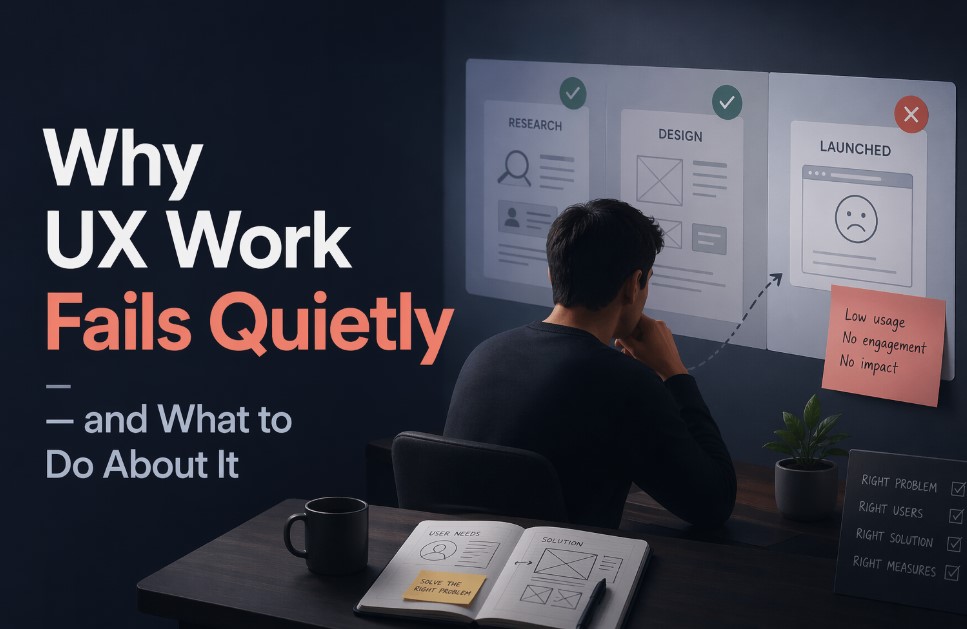
Most UX projects don’t fail loudly.
There’s no clear breakdown. No obvious mistake. The redesign ships, the product looks better, stakeholders feel confident — and then nothing really changes.
Conversion stays flat. Activation barely moves. Retention behaves exactly as before.
At that point, teams start looking elsewhere. Traffic quality. Pricing. Competition.
Sometimes they’re right.
But often, the issue sits closer than that.
The real problem isn’t design quality
If you review typical lists of user experience design services, you’ll see a pattern. Strong visuals, structured case studies, well-known clients. On the surface, everything checks out.
But those lists don’t answer a more important question: did the work actually change how users behave?
That’s the uncomfortable gap in most UX engagements.
Because design quality is rarely the issue. Most agencies can produce clean, modern, well-structured interfaces. The real problem is that this level of improvement doesn’t automatically translate into business impact.
A better-looking product is not the same thing as a better-performing one.
And yet, teams often treat it as if it is.
UX is often applied too late to matter
By the time a UX team gets involved, key decisions are already locked in.
The product structure is defined. Core flows are set. Messaging is more or less agreed on. What’s left is to “improve the experience.”
At that stage, design becomes reactive.
You can simplify steps. You can make interactions clearer. You can remove obvious friction. But you’re still operating inside a system that may have deeper issues.
If users don’t fully understand the value, or if the flow doesn’t match how they think about the problem, interface improvements won’t fix that.
They’ll just make the existing issues slightly easier to navigate.
This is why many redesigns feel successful internally but don’t show up in metrics. The work was done at the wrong level.
Execution solves requests. It doesn’t always solve problems.
There’s a subtle but important difference here.
Most teams approach a user experience agency with a clear request. Redesign this. Improve onboarding. Clean up the dashboard.
A good agency will execute that well.
But execution alone doesn’t guarantee that the original request was the right one.
We’ve seen cases where the onboarding flow wasn’t the real issue — it was the mismatch between what marketing promised and what the product delivered. Or where the dashboard wasn’t confusing, just overloaded with features that didn’t belong there in the first place.
If you don’t question the problem, you risk solving the wrong thing more efficiently.
That’s how you end up with polished experiences that don’t move the needle.
The role of strategy — and why it’s often missing
UX tends to sit downstream from product and marketing decisions.
Strategy happens first. Then UX adapts.
In theory, that sounds reasonable. In practice, it limits what UX can influence.
Because many of the issues that affect user behavior are not visual. They’re structural. They sit in how the product is positioned, how value is communicated, how users move from one step to the next.
Once those decisions are made, UX can refine them, but not fundamentally change them.
That’s where the difference shows up when you look at top strategic design companies. The work starts earlier. It shapes the product before it becomes rigid.
Instead of asking “how do we improve this flow,” the question becomes “should this flow exist in this form at all?”
It’s a different conversation.
And it leads to different outcomes.
Why teams misread what’s happening
There’s a tendency to equate visible change with real progress.
A new interface is visible. A refined layout is visible. A design system is visible.
But the things that actually affect performance are often less obvious. Clarity of value. Alignment between expectations and experience. The ease with which a user can make a decision and move forward.
When those don’t change, metrics don’t change.
And because the design work looks like progress, teams assume the problem must be somewhere else.
This is where UX gets unfairly blamed — or worse, quietly deprioritized.
What to pay attention to instead
If the goal is to improve product performance, the conversation needs to shift.
Not toward more design output, but toward better problem definition.
A strong UX partner doesn’t just ask what needs to be designed. They ask why users behave the way they do. Where hesitation comes from. What’s unclear, missing, or misaligned.
They’re willing to challenge the brief. Sometimes that means less design work, not more.
That’s not always comfortable. But it’s usually where the real gains are.
The takeaway most teams overlook
UX becomes valuable when it’s allowed to influence decisions, not just express them.
If it’s brought in late, scoped narrowly, and measured by deliverables, it will produce exactly that — deliverables.
Well-crafted, thoughtful, and ultimately limited in impact.
If it’s involved earlier, tied to how the product works and how users understand it, the effect is different. You start seeing changes in behavior, not just in visuals.
And that’s the point where UX stops being a cost center and starts acting like a growth lever.


How to Choose an Ergonomic Office Chair for Women That Actually Fits

Top Movies and TV Shows in the US: JustWatch September 2026 Streaming Charts

5 Best Indoor Air Quality & Mold Companies in Houston (2026)

The Spreadsheet Habit That Quietly Breaks Business Dashboards as Teams Scale

Marie-France Ward: Fred Ward’s Wife, Marriage, Family, Age and Life After His Death
-

 Celebrity1 month ago
Eileen Gu: Age, Parents, 2026 Olympics, Modeling Career, Height and Personal Life
-

 Tech1 month ago
18Moa – Website Directories, Online Discovery, and Safer Browsing
-

 Animals1 month ago
Understanding the American XL Bully Ban in the UK: Rules and Changes in 2026
-

 Tech2 months ago
WhatsApp Chat Theme Not Showing? How to Fix It