
Home Improvement
Why One Thermostat Can’t Keep The Whole House Comfortable?

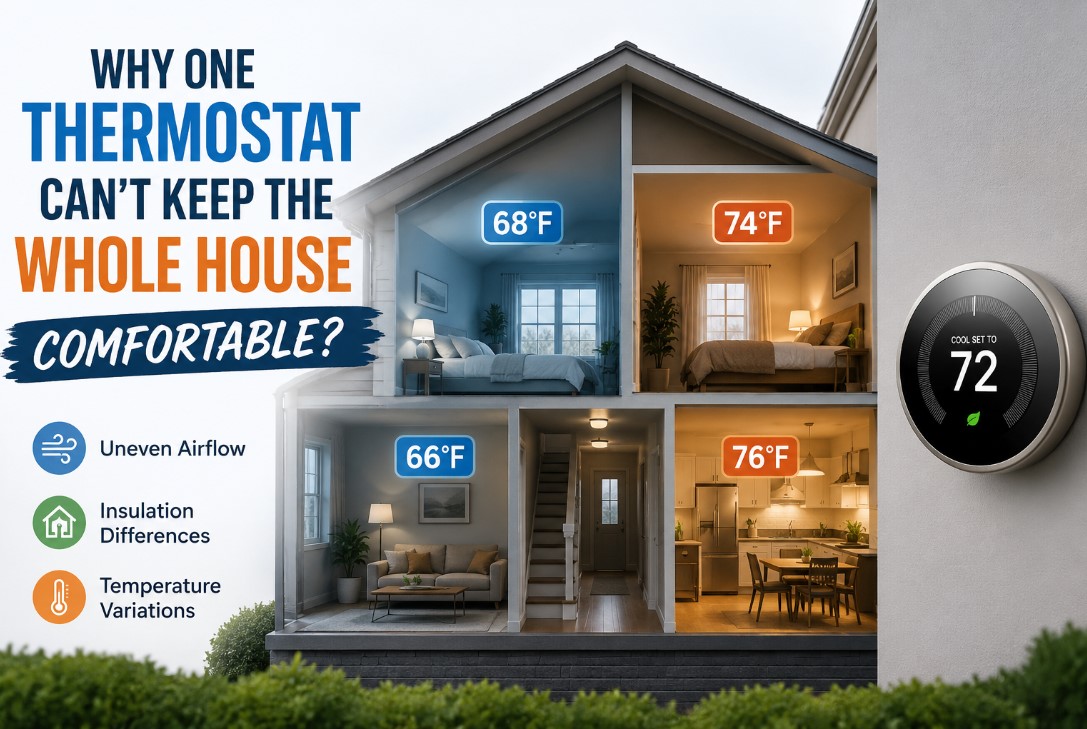
Most homeowners assume uneven temperatures mean it’s time for an HVAC replacement. Before you spend thousands on new equipment, the real culprits are usually hiding in your attic, your ductwork, and your walls, and fixing them costs a fraction of the price. Here’s what’s actually going on.
Why is One Room Hotter Than the Rest?
Your HVAC system was sized for the whole house as an average. It dumps conditioned air into a duct network routed wherever it could fit, around joists, through cramped attic spaces, behind walls. The room farthest from the air handler, the room with the biggest window wall, the room above the garage, these were afterthoughts. Nobody modeled the airflow. Nobody measured whether that duct run had enough capacity for the square footage it served.
Why is one room hotter than the rest while another feels like a freezer? The answer is rarely the thermostat.
That hot room isn’t just a comfort complaint. It’s evidence that your home’s thermal envelope, duct system, and HVAC capacity are mismatched in at least one place, and usually more than one. Most homes weren’t designed with airflow as a first-class concern, they were designed around aesthetics, square footage, and code minimums. Comfort came last, and it shows.
That room is also frequently telling you something about construction shortcuts: undersized ducts, a missing return vent, fiberglass batt insulation stuffed around a duct boot (which blocks airflow more than it helps), or a duct that silently disconnected in the attic and has been dumping cold air into unconditioned space for years. Most homes built before 2010, and many after, were never tested with a blower door or duct leakage test. They were built on assumptions. That hot room is the assumption that didn’t hold.
Supply and return vents aren’t a matched pair in most homes. Contractors install returns where they’re easy to run, not where airflow physics demands them. A room with two supply registers but no dedicated return is in a constant pressure battle, the room pressurizes slightly every time the system runs, and that back-pressure reduces how much conditioned air actually enters. The room feels starved because it is. The fix is often a $200 door undercut or transfer grille, not a new system.
Uneven heating and cooling in house is almost always a pressure and distribution story, not an equipment story.
Duct dampers, the small adjustable plates inside duct collars, exist specifically to balance airflow across rooms. Most homeowners have never touched them. Most HVAC installers set them and forget them during commissioning. Rebalancing them seasonally (more flow upstairs in summer, more downstairs in winter) costs nothing and is genuinely effective.
When some rooms are colder than others despite the same duct layout, damper rebalancing is the first thing to try before calling anyone.
Why is My Upstairs Hotter Than Downstairs? Uneven Heating and Cooling in House
Three forces all push heat upward at the same time, and your HVAC system is usually fighting all three with inadequate tools.
Hot air rises, though this is real but often overstated, and matters more in open floor plans than in houses with closed upstairs hallways. Your attic is the bigger culprit. On a summer day, an unventilated or poorly insulated attic routinely hits 140-160°F. That heat radiates through your ceiling drywall all day long and continues into the evening. Your air conditioner can’t cool the upstairs as fast as the attic is heating it. (~40% of cooling load in a typical home comes through the roof and ceiling plane, and a dark asphalt roof amplifies solar gain roughly 2× versus a reflective surface.)
Uneven heating and cooling in house tends to show up most dramatically between floors, and attic heat radiation is the primary reason.
Then there are duct losses. In most homes, ducts run through the attic. An attic at 150°F surrounding a duct carrying 55°F air isn’t delivering 55°F air, it’s delivering something warmer, and the energy loss is substantial before that conditioned air even reaches the upstairs register.
Your thermostat is almost certainly downstairs too. So when the downstairs hits setpoint, the system shuts off, while the upstairs may still be 5-8 degrees warmer. The system is satisfying the sensor, not the space where you’re actually sleeping.
Before adding thermostats or zoning equipment, address attic insulation and duct insulation. Air sealing the ceiling plane is often the highest-ROI move, stopping the stack effect matters more than most equipment-based solutions, which work much better on a tightened envelope.
A foil radiant barrier installed on the underside of attic rafters blocks 95%+ of radiant heat transfer from the roof deck before it ever reaches your insulation. It doesn’t replace insulation, it works alongside it. In hot climates, this single addition can drop attic temperatures by 20-30°F and reduce upstairs cooling load meaningfully. Cost is around $500-1,500 installed, and it’s often more effective per dollar than adding more insulation on top of existing insulation.
Hot and cold spots in house that are floor-dependent almost always trace back to attic conditions, not the HVAC unit itself.
Recessed lighting is similarly overlooked. Recessed can lights in an upstairs ceiling are essentially holes connecting your living space to the attic, both thermally and in terms of air leakage. A ceiling with 20 recessed cans can leak more air than an open window. Air-sealing those cans from the attic side is tedious work that most contractors skip, but it’s one of the highest-impact interventions for upstairs comfort.
Hot and Cold Spots in House: HVAC or Something Else?
It’s rarely just an HVAC problem. The HVAC system gets blamed because it’s the most visible piece, but it’s usually the last domino, not the first. Think of your home as a system with three layers: the thermal envelope (walls, windows, ceiling, floor), the distribution system (ducts, vents, returns), and the generation equipment (furnace, air handler, heat pump). Hot and cold spots can originate in any layer, and frequently in multiple layers at once.
Hot and cold spots in house are a layered problem, envelope, distribution, and equipment all contribute, and fixing only one layer rarely solves the complaint.
Solar gain means a room with west-facing glass gets punished every afternoon. No HVAC adjustment compensates for a window that’s turning sunlight directly into heat load, the fix is shading, window film, or window replacement. Old homes also leak: cold air seeps in around outlets, plumbing penetrations, attic hatches, recessed lights, and a room adjacent to a leaky wall can be 4-6°F colder in winter regardless of how much heat the furnace produces.
This is why some rooms are colder than others even in well-maintained homes, the problem lives in the walls, not the mechanical room.
Metal framing, concrete slabs, and poorly insulated rim joists create cold pathways through thermal bridging, the corner bedroom above a garage is a classic example, surrounded by unconditioned space on two or three sides.
On the distribution side: disconnected ducts, undersized supply runs, missing or blocked return vents, dampers stuck in the wrong position. These are installation or maintenance failures, not equipment failures. Room geometry compounds things, long narrow rooms, rooms with high or vaulted ceilings where warm air stratifies near the peak all need different airflow strategies than standard rooms.
If a room is uncomfortable in one season only, it’s usually a solar or infiltration problem. If it’s uncomfortable year-round, suspect duct distribution. If it’s only uncomfortable when the system runs a lot, look at equipment sizing and airflow balance.
Furniture and rugs block return airflow more than people realize. A couch pushed against a wall return grille, or a thick area rug over a floor return, can cut the effective return area by 50-70%. The system keeps running but increasingly starved for return air, which drops static pressure and reduces airflow to every room on that circuit, not just the blocked one.
The “cold corner bedroom” is almost always a building science problem disguised as an HVAC problem. Corner rooms have more exterior wall area per square foot of floor space than interior rooms, they lose heat through two walls instead of one. The fix isn’t more airflow; it’s insulation continuity at the corner framing, where most homes have a structural stud cavity with little to no insulation. Dense-pack insulation injected into those cavities is the specific fix building science prescribes.
Hot and cold spots in house that track with exterior wall exposure are almost always insulation and framing problems wearing an HVAC mask.
Why Uneven Heating and Cooling Gets Worse Over Time
This is one of the most important and least-discussed truths in residential HVAC: systems degrade in ways that are invisible until the cumulative effect becomes uncomfortable. And the degradation often accelerates, because small problems create conditions that cause bigger problems.
Uneven heating and cooling in house doesn’t announce itself, it creeps up over years as duct efficiency quietly erodes.
Duct leakage grows slowly. Flex duct sags and develops micro-tears. Mastic sealant at duct connections dries and cracks. Tape, which was never the right sealant, peels. (Duct tape was never meant for ducts; the name is a historical accident. Actual duct tape, the silver fabric kind, fails within a few years in attic temperature extremes. UL-181 rated mastic or metal foil tape is what holds. Homes built before roughly 2005 are overwhelmingly sealed with the wrong product, and it’s been failing quietly for years.) A system that was 85% efficient at installation may be 70% efficient ten years later, but it still “works,” so nobody notices until the hottest week of summer.
As duct leakage worsens, the system runs longer cycles to meet the thermostat setpoint. Longer cycles mean more time for heat exchange across the duct walls in the attic. More heat exchange means the delivered air is less conditioned. The room at the end of the longest duct run suffers most, and it gets progressively worse each year.
Blown-in attic insulation compresses over years, losing R-value. Fiberglass batts installed with gaps, which is most of them, allow convective loops to form inside the wall cavity that weren’t there when the insulation was new. Meanwhile the house itself shifts: foundations settle, framing dries out and shrinks, caulk fails. Air sealing that was adequate at year five develops gaps that compound over time. Penetrations that were tight slowly become pathways.
Coils accumulate dirt and the heat exchanger surface area gets fouled. Variable-speed equipment can compensate somewhat, but single-stage equipment just runs longer cycles, which increases duct losses. Most air handlers also have a small gap around the filter, sometimes a quarter inch or more. Over years, that gap allows unfiltered air to bypass the filter entirely, depositing debris directly onto the evaporator coil. A dirty coil loses heat exchange efficiency gradually and invisibly. Comfort drops; nobody connects it to a gap around a filter frame.
Why is one room hotter than the rest after years of seemingly adequate performance? Usually because several small degradation factors finally crossed a threshold at the same time.
This is why a home that was “fine” for years suddenly feels unbearable: you’ve been accumulating small deficits that finally hit a threshold. The good news is that testing and air sealing can often recover much of what was lost, without any new equipment.
Why a Single Thermostat Can’t Fix the Problem
A thermostat is a single-point temperature sensor. It knows exactly one thing: the air temperature within about 18 inches of where it’s mounted. Everything beyond that, humidity, radiant heat from surfaces, the 8°F difference between your living room and your upstairs bedroom, is invisible to it.
The thermostat’s job is to turn the system on and off. It does that job faithfully. But it was never designed to ensure that every room in the house is comfortable, that’s a distribution problem, and the thermostat has no influence over distribution at all. A thermostat controlling your HVAC is like a light switch controlling every lamp in your house simultaneously. The switch works perfectly. But if one room is dark because its lamp is broken or because there’s no lamp in it at all, the switch can’t help. The problem is upstream of the switch.
Most thermostats are installed in a hallway or on a main-floor wall, a relatively stable, well-mixed zone that is often the most comfortable room in the house. So the system satisfies the sensor before it satisfies the bedrooms, the bonus room over the garage, or the finished basement.
In summer, relative humidity above 55% feels warmer than the temperature suggests. A single-stage system that short-cycles never runs long enough to dehumidify effectively. The room feels hot even when the temperature reads correctly, and the thermostat can’t see any of this.
Smart thermostats with remote sensors can average temperatures across multiple rooms or prioritize a specific room at specific times. But they’re still controlling a single zone, they can deliver more or less of the same conditioned air, but they can’t route it differently or treat different parts of the house as independent systems.
This is why some rooms are colder than others even when the thermostat reads exactly what you set, the sensor is satisfied long before every room is.
The temperature you feel in a room is not the air temperature, it’s a combination of air temperature and the temperature of the surfaces around you. A room with cold walls, a cold concrete slab floor, or large single-pane windows can have perfectly conditioned air at 70°F and still feel cold, because your body is radiating heat toward those surfaces. The thermostat reads 70 and calls it done. Your body disagrees. No thermostat adjustment fixes this, it requires addressing the surface temperatures themselves.
Why is one room hotter than the rest when the thermostat looks fine? Because thermostats measure air, not surfaces, and not every room in the house.
Can You Have More Than One Thermostat in a House? Multiple Thermostats Explained
The answer differs significantly depending on whether you have a zoned system, a multi-unit system, or just a single system with added sensors.
Multiple thermostats in house setups range from a simple sensor add-on to a fully zoned system with motorized dampers, and those two things are very different.
The simplest version: a smart thermostat with remote room sensors (like an Ecobee with SmartSensors) gives you temperature data from multiple rooms while still controlling a single zone. You can tell it to prioritize the bedroom at night or to average temperatures across three rooms. The thermostat still controls one system, it just has better information. This costs $150-300 and takes an afternoon.
If your home has two separate HVAC systems (common in two-story homes over ~2,500 sq ft), each has its own thermostat and they operate independently. This is the cleanest solution, each floor or wing has its own air handler, its own ductwork, its own control.
One system with multiple thermostats uses motorized dampers in the ductwork, where each thermostat controls the dampers for its zone. This is real zoning, the thermostats are actually routing airflow, not just measuring temperature. In this setup, the thermostats need to be wired to a zone control board, not directly to the HVAC unit. That board arbitrates between competing zone calls, manages the bypass damper, and protects the equipment. Homeowners who buy a second smart thermostat and try to wire it in parallel with the first often create conflict conditions that short-cycle the system or lock it up. The board is what makes it a system rather than two thermostats fighting each other.
Multiple thermostats in house installations that skip the zone control board often create more problems than they solve, equipment conflicts, short-cycling, and no real improvement in the rooms that need it most.
Mini-split systems give each head unit its own remote or wall controller. A home with four mini-split heads effectively has four independent thermostats, each room or zone completely independent, which is the most granular comfort control available.
Multiple thermostats in house configurations that use mini-splits offer the most granular control, because each head is a fully independent refrigerant circuit, not just a sensor.
The critical question before adding any thermostat is: what is the thermostat controlling? A second thermostat that controls nothing new, just measures temperature in another room, gives you information but doesn’t change outcomes. An Ecobee with two remote sensors will produce real improvement in 2-3 rooms for modest cost. Full zoning or a mini-split added to a problem room is a larger investment but solves the problem at its source.
One Thermostat vs. Full Zoning System, What’s the Difference?
Adding a second thermostat to a single-zone system without changing anything else is, at best, a data upgrade. Adding a full zoning system is a fundamental change to how conditioned air is distributed. They’re often confused because they both involve thermostats, but they’re doing completely different things.
In a zoned system, the thermostats actually control motorized dampers inside the ductwork. When Zone 1 (downstairs) reaches setpoint and Zone 2 (upstairs) is still warm, the dampers close the downstairs supply vents and direct airflow to the upstairs. The thermostat is the controller; the damper is the actuator. Without the damper, the thermostat is just a gauge. A typical residential zoning system has 2-4 zones and costs $2,500-5,000 installed as a retrofit on an existing single system.
Zoning systems also require a bypass damper or a variable-speed air handler to manage the pressure problem: when you close off one zone, the remaining ductwork sees higher static pressure. A fixed-speed system fighting high static pressure can damage the blower and reduce airflow to the open zones. The bypass damper is the piece that determines whether a zoning system works or destroys equipment, excess pressure has to go somewhere, ideally through a barometric bypass damper that opens automatically to route air back to the return. Systems installed without one, or with an undersized one, push the blower into its high-static operating range continuously. That’s how motors burn out and heat exchangers crack. Any zoning quote that doesn’t explicitly mention bypass damper sizing is an incomplete proposal. Good zoning design accounts for this, cheap zoning installations often don’t, which is why some homeowners report zoning that “doesn’t work.”
Zoning solves uneven comfort by routing air where it’s needed, but it doesn’t increase total capacity. If your system is undersized for your home’s load, zoning won’t fix that. Zoning works best when the fundamental system capacity is adequate and the problem is distribution.
Mini-split systems sidestep this entirely, each head unit is a self-contained refrigerant circuit with its own compressor capacity. When you add a mini-split to a problem room, you’re adding real capacity and independent control, not just rerouting existing airflow. The two approaches aren’t competing, many well-conditioned homes use both.
Some Rooms Are Colder Than Others, How to Find the Real Fix
The diagnostic process matters enormously here, because misidentifying the root cause leads to spending money on the wrong fix.
When some rooms are colder than others, the season test is the fastest way to point at a cause without opening a wall or climbing into the attic.
Start with the season test: is the room uncomfortable in summer only, winter only, or year-round? Summer-only suggests solar gain or inadequate cooling capacity for that zone. Winter-only suggests insulation, air infiltration, or inadequate heating delivery. Year-round suggests a structural problem with distribution, a duct issue, an undersized supply run, or a missing return.
Then check the supply register. Put your hand over it when the system is running. Weak airflow points to a duct problem (undersized, leaky, disconnected, or blocked). Strong airflow of the wrong temperature points to an equipment or refrigerant issue. No airflow means the duct run may have completely failed. For more detail, tape a tissue or thin piece of toilet paper over the register and watch it during a full system cycle. One that flutters strongly at startup and stays strong through the cycle suggests adequate duct flow. One that flutters weakly, or weakens significantly after a few minutes, suggests either a partially blocked duct or that the system is short-cycling before the duct pressurizes properly.
Also check the delta-T across the air handler: measure supply air temperature at the register and return air temperature at the return grille. In cooling mode, a properly functioning system delivers air 15-20°F cooler than what it’s pulling in. A delta of 8-10°F means the coil is dirty, refrigerant is low, or airflow is too high. A delta over 22°F means airflow is too low. This takes a $12 infrared thermometer.
Some rooms are colder than others not because the equipment is failing, but because the air being delivered has already lost its conditioning before it arrives.
On a cold day, put your hand flat against exterior walls, around window frames, and near electrical outlets. Cold surfaces indicate insulation gaps or air infiltration. If the walls feel fine but the room is still cold, the problem is likely delivery (ducts), not the envelope.
Also check for a return vent. Many problem rooms have supply vents but no return. Without a return, pressure builds up in the room when the door is closed, actively pushing conditioned air back out of the supply register. The fix is cheap: either add a return vent or undercut the door by an inch to allow air to escape into the hallway.
Hot and cold spots in house diagnostics almost always turn up a missing return, it’s the most common overlooked cause and the cheapest fix on the list.
The most common misdiagnosis is buying a new thermostat or adding a duct booster fan when the actual problem is a disconnected duct in the attic or a room with no return path. If DIY testing doesn’t isolate the problem, a Manual J load calculation tells you whether the room is getting the airflow it theoretically needs, a duct blaster test tells you how much conditioned air is escaping into the attic, and a blower door test tells you how leaky the envelope is. These tests cost $200-600 and can save thousands in misdirected fixes.
What to Expect After Fixing Uneven Heating and Cooling
Realistic expectations depend entirely on what was fixed, and the HVAC industry tends to oversell outcomes.
Proper attic air sealing and insulation should produce a 3-6°F reduction in upstairs temperatures in summer, noticeably more even temperatures throughout the day, and lower energy bills, typically 15-25% in a home that was previously poorly sealed. Uneven heating and cooling in house doesn’t disappear overnight, even after good work, the first season is an adjustment as the envelope and distribution system reach a new equilibrium. It will not achieve perfect temperature uniformity in every room on its own.
Adding zoning to a well-functioning system lets you prioritize comfort in specific zones at specific times and reduces the “one floor satisfied, another not” problem, with slightly better efficiency because the system isn’t overcooling some zones to satisfy others. You will still have temperature variation within each zone. Adding a mini-split to a problem room means that room will be genuinely comfortable and independently controlled, regardless of what the rest of the system does, the most reliable fix for a chronic problem room.
When some rooms are colder than others despite every duct and insulation fix, a dedicated system is the honest answer.
“Solving” uneven heating and cooling typically means reducing the delta from 8-12°F between rooms to 2-4°F. A perfectly uniform home requires either a very tight envelope, a sophisticated multi-zone system, or both. Most homeowners find that a 60-70% improvement in comfort is achievable with targeted fixes, and that’s genuinely life-changing for the rooms they use most.
Some homes have a room that will never be fully comfortable without its own dedicated system. A converted garage, a sunroom, a bonus room over an unconditioned space, these were built outside the original thermal design of the house. Trying to serve them from the central system is engineering against the structure. A single mini-split head is usually the right answer, and accepting that early saves years of chasing a solution that doesn’t exist.
The first summer after air sealing and insulation work is often the worst time to evaluate results, because most homeowners fix things in spring and then face an unusual heat event. The real proof comes in year two, when you have a comparison baseline. Track utility bills by month against the prior year, not against neighbor averages. A 15% reduction in summer cooling costs is a meaningful result. A 5% reduction after a $4,000 investment is a signal that something wasn’t addressed correctly.
Hot and cold spots in house that persist after sealing and insulation work usually mean the distribution layer, ducts, was never properly addressed.
The homes that maintain comfort over decades are the ones treated as integrated systems, not collections of independent appliances. Envelope, distribution, and equipment degrade together and need to be evaluated together. Replace filters on schedule (monthly for 1″ filters in high-dust homes, every 90 days for thicker media filters), have coils cleaned annually, and keep all supply and return registers open and unobstructed. Every 3-5 years, recheck attic insulation depth, have dampers in a zoning system tested, and verify refrigerant charge if a system seems to be losing cooling capacity gradually. After major weather events, check that duct connections in unconditioned spaces are still intact, insulation can shift during temperature extremes, and pest intrusion into duct systems is worth checking after extended periods of extreme heat or cold.



Eileen Gu: Age, Parents, 2026 Olympics, Modeling Career, Height and Personal Life

18Moa – Website Directories, Online Discovery, and Safer Browsing

Understanding the American XL Bully Ban in the UK: Rules and Changes in 2026

Best UI/UX Design Agencies for Enterprise Products in 2026

Broken Keyboard Grok Answer: How to Understand and Solve the Coding Problem
-
 Celebrity4 weeks ago
Eileen Gu: Age, Parents, 2026 Olympics, Modeling Career, Height and Personal Life
-
 Tech4 weeks ago
18Moa – Website Directories, Online Discovery, and Safer Browsing
-
 Animals4 weeks ago
Understanding the American XL Bully Ban in the UK: Rules and Changes in 2026
-

 Tech2 months ago
WhatsApp Chat Theme Not Showing? How to Fix It