
Home Improvement
Why Your AC Runs All Day but Your House Still Feels Hot

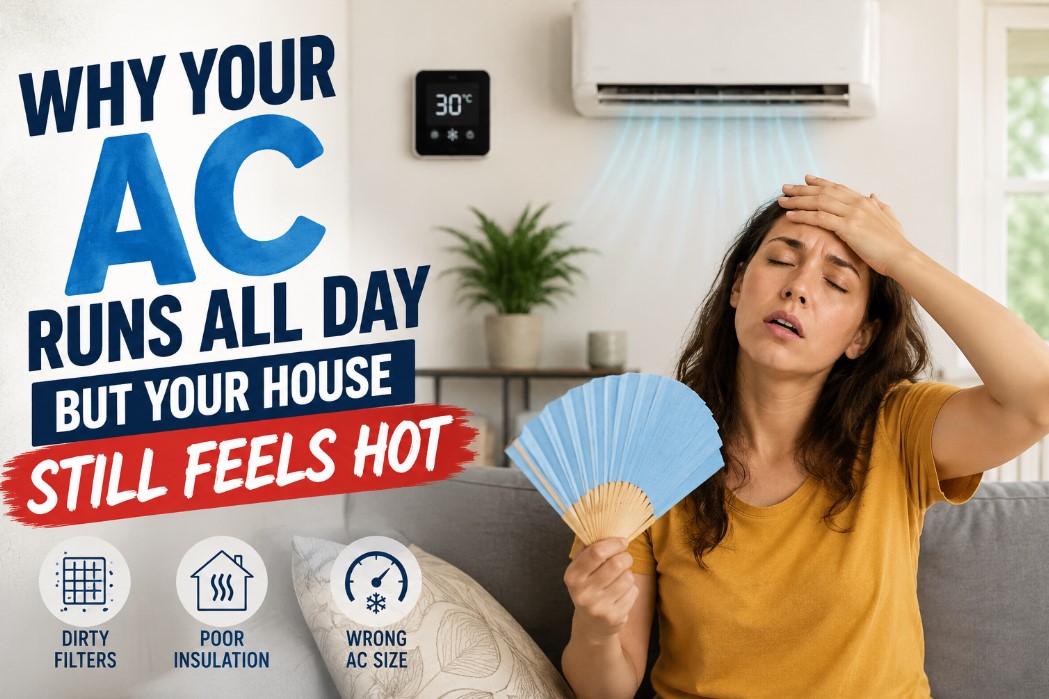
When your air conditioner runs nonstop, but your home still feels warm, it usually means something is stopping the system from cooling efficiently. Before assuming you need a full replacement, it helps to understand the most common causes and when AC repair may be the right next step.
Why Is My House So Hot Even With AC?
Your house may still feel hot with the AC on because the system is either not removing enough heat, not moving enough air, or fighting against more heat than it can handle. If your house is still hot with the AC on, the main problem may be inside the system, in the ductwork, or in the home itself. Common causes include a dirty air filter, low refrigerant, dirty coils, blocked vents, leaky ducts, incorrect thermostat settings, an aging system, or an AC unit that is too small for the home.
When your house is still hot with AC on, the situation usually comes down to one of two problems: the system is not removing enough heat, or the home is gaining heat faster than the system can remove it. Many homeowners assume the AC unit is “bad,” but the real issue could be a hot attic, leaking ducts, poor insulation, sun-facing rooms, dirty equipment, or an airflow problem. In other words, the AC may be working hard, but the house is making the job nearly impossible.
A useful way to think about it is this: your AC does not “create cold.” It removes heat from the indoor air and releases it outside. Anything that blocks that heat-removal process, like dirty coils, low refrigerant, poor airflow, or a struggling outdoor unit, can leave the house warm. Anything that adds too much heat, like attic heat, duct leaks, large windows, or poor insulation, can do the same.
A helpful first clue is the air coming from your vents. If the AC is running but the air feels room-temperature or only slightly cool, the problem may be refrigerant, coils, compressor performance, or outdoor unit operation. If the air feels cold but the house still will not cool down, the issue may be poor airflow, duct leaks, insulation problems, heat gain from windows, or an undersized system.
Also consider the weather. On extremely hot days, an AC may run longer than usual, but it should still gradually lower the indoor temperature. If your system runs all day and the temperature barely moves, something is not working efficiently.
Before assuming you need a new unit, pay attention to the pattern. If the AC doesn’t cool during the hottest part of the day but works better at night, that clue matters. Is every room hot, or only certain rooms? Is the air from the vents warm, weak, or cold but not enough? Does the AC cool at night but fail in the afternoon? Those clues often point to very different problems.
AC Running But Not Cooling?
When your AC is running but not cooling, there is a big difference between weak cooling and a system that is only blowing air. Sometimes the indoor fan is running, but the air conditioner is not actually cooling. In that case, the system is basically acting like a large house fan, moving warm indoor air around without removing heat.
When the AC is working correctly, you should feel noticeably cool air from the supply vents, and the outdoor unit should usually be running while the indoor blower is on. During a normal cooling cycle, the indoor blower and outdoor unit usually work together.
When you notice the AC running but not cooling, a simple test is to place your hand near a supply vent. If the air feels cool but weak, you may have an airflow problem. If the air is strong but not cold or feels room-temperature, the system may not be actively cooling. Then check the outdoor unit. If the indoor fan is blowing but the outdoor unit is silent, humming, clicking, not spinning, or off, your AC may be circulating indoor air without removing heat.
This can happen because of a tripped breaker, faulty capacitor, thermostat issue, compressor problem, refrigerant issue, safety shutoff, safety switch, or wiring issue. If the outdoor unit is humming but the fan is not spinning, turn the system off and call a technician. Continuing to run it may cause more damage.
Do not keep lowering the thermostat repeatedly. That usually will not fix the issue and may put more stress on the system.
The key point with AC running but not cooling is this: “air coming from the vents” does not always mean “AC is cooling.” It may only mean the blower is on.
Dirty Filter And AC Running Constantly
A dirty air filter is one of the most common reasons for the AC running constantly but not cooling the home well. The bigger issue is not just that the filter is dirty. It is possible that a clogged filter can choke the entire system.
Your AC needs a steady flow of warm indoor air moving across the evaporator coil. When the filter is packed with dust, the system cannot breathe. Less air passes over the coil, less air gets cooled, less cool air reaches your rooms, and the AC runs longer trying to make up the difference.
A clogged filter can also cause bigger problems. Restricted airflow may make the evaporator coil get too cold and freeze. Once ice forms, the system may blow even less air and cool even worse. Your AC may run for hours while cooling gets worse and worse, which is why this problem should not be ignored. You may notice weak airflow, ice on the indoor unit or refrigerant lines, higher energy bills, uneven temperatures, or a system that seems to never shut off.
Check the filter first because it is one of the easiest fixes. If it looks gray, dusty, matted, or you cannot see light through it, replace it. After changing the filter, give the system time to recover. If cooling does not improve, the dirty filter may have caused or revealed another issue that needs service.
The standout advice here is this: do not judge the filter only by the calendar. A “90-day filter” may not last 90 days in a home with pets, dust, remodeling, heavy AC use, or a return vent near the floor. If your AC is struggling, check the filter even if you replaced it recently.
Thermostat Issues And AC Doesn’t Cool
Yes, thermostat settings can make your AC run all day, especially if the thermostat is set too low, placed in a bad location, or programmed incorrectly. In some cases, it can look like AC doesn’t cool when the thermostat is actually the source of the problem.
Start by confirming the thermostat is set to “Cool,” not just “Fan.” Then check whether the fan is set to “On” or “Auto.” If it is set to “On,” the blower may run constantly even when the AC is not actively cooling. That can make it seem like the air conditioner never shuts off, even though only the fan is running. “Auto” is usually the better setting for normal cooling because the fan runs during cooling cycles.
Next, look at the temperature setting. If the thermostat is set much lower than the current indoor temperature, the system may run nonstop trying to reach a target it cannot realistically hit, especially during extreme heat. If it is 95°F outside and the thermostat is set to 65°F, the AC may run nonstop chasing a temperature it cannot realistically reach. That does not always mean the system is broken; it may mean the target is too aggressive for the heat load. A typical AC is designed to lower indoor temperatures gradually, not instantly.
Thermostat location matters too. If it is near a sunny window, kitchen, exterior door, lamp, TV, electronics, warm hallway, or poorly insulated wall, it may sense extra heat and keep calling for cooling. A thermostat does not know the whole house. It only knows the temperature where it is installed.
If the thermostat screen is blank, inaccurate, delayed, or unresponsive, it could also be part of the problem. A good clue is whether nearby rooms feel comfortable while the thermostat area stays warm. If so, the issue may be thermostat location, room imbalance, or airflow, not necessarily the AC unit itself.
Low Refrigerant And AC Won’t Cool
Low refrigerant can make an air conditioner run continuously while doing very little cooling. Refrigerant is the substance that absorbs heat from inside your home and releases it outside. When the refrigerant level is low, the system cannot move heat properly, so the AC may stay on longer and longer without reaching the thermostat setting.
But the important detail is this: refrigerant is not supposed to disappear. Low refrigerant is not something that gets “used up” like fuel. If the level is low, there is usually a leak somewhere in the system.
Signs of low refrigerant can include warm air from the vents, weak cooling, ice on the refrigerant line or evaporator coil, hissing or bubbling sounds, longer run times, rising energy bills, and poor cooling during the hottest part of the day.
Low refrigerant can also lead to freezing. When pressure drops, the evaporator coil can become too cold, moisture freezes on the coil, airflow drops, and cooling gets worse. The AC may keep running, but the house gets hotter. This is one of the reasons AC won’t cool, even though the system appears to be on.
This is not a DIY repair. Simply “topping it off” may temporarily improve cooling, but it does not solve the reason the refrigerant was low in the first place. That is why some homeowners pay for refrigerant one summer and have the same problem again the next summer, or even a few weeks later.
A licensed HVAC technician should inspect the system, locate the leak, repair it when possible, and charge the unit to the correct level.
Dirty Coils And AC Running But Not Cooling
Dirty coils can absolutely keep an AC from cooling the house properly. Your air conditioner has two major coils: the evaporator coil inside and the condenser coil outside. The indoor coil absorbs heat from your home, and the outdoor coil releases that heat outdoors. If either coil is coated with dirt, dust, pollen, grass clippings, or debris, heat cannot move efficiently.
Here is the more memorable explanation: dirty coils act like a blanket. The system is trying to move heat, but the dirt layer insulates the coil and traps heat where it does not belong.
A dirty evaporator coil may cause weak cooling, poor airflow, musty odors, ice buildup, or longer run times. A dirty condenser coil can make the outdoor unit work harder because it cannot release heat efficiently. You may notice AC running constantly, blowing warmer air, making unusual noises, using more electricity, overheating, or struggling most during the hottest part of the day.
Outdoor condenser coils often collect grass clippings, leaves, cottonwood, dirt, and debris. Keeping the area around the outdoor unit clear can help, but deep coil cleaning should be done carefully. Bent fins, electrical components, and refrigerant lines can be damaged by rough cleaning or high-pressure washing.
Homeowners can safely keep leaves, weeds, and debris away from the outdoor unit, but deep coil cleaning should be handled carefully. Cleaning the indoor coil usually requires opening equipment panels.
Air Conditioner Running But Not Cooling the House?
When an air conditioner is running but not cooling the house, poor airflow can make the system seem like it is failing, even when the cooling equipment itself is working. Your system has to move enough conditioned air through the ductwork and into each room. If airflow is restricted or leaking, the cool air may never reach the spaces that need it.
In many homes, the AC equipment may be cooling air, but the duct system is failing to deliver that air where it belongs. That is why the air conditioner is running, but not cooling the house. It can sometimes be a ductwork issue, not only an equipment issue. That is why airflow problems can be so frustrating. The system runs. The electric bill rises. Some air comes out of the vents. But the rooms still feel hot.
Start with the visible basics. Make sure supply vents are open and not blocked by furniture, rugs, curtains, storage, boxes, or pet beds. Check return vents too. Return vents pull air back into the system, and blocking them can reduce circulation throughout the home.
Duct problems are more hidden but very common. Leaky, crushed, disconnected, poorly insulated, or undersized ducts can waste a large amount of cooled air in attics, crawl spaces, garages, or wall cavities. A disconnected duct in an attic or crawl space can dump cooled air into an unconditioned area. Leaky ducts can pull hot attic air into the system or lose cooled air before it reaches the room. Crushed or undersized ducts can starve certain rooms of airflow.
The clue is room-by-room comfort. If one or two rooms are hot, the problem may be duct balancing or a branch duct issue, especially when the main complaint is the air conditioner running but not cooling the house evenly. If the whole home is warm and airflow is weak everywhere, the problem may be filter restriction, blower performance, dirty coils, return-air limitations, duct leakage, or system performance.
Old Or Undersized AC Doesn’t Cool
If your AC has always struggled to cool the home, it may be undersized, poorly installed, or connected to ductwork that was never designed correctly. This can leave the house still hot with the AC on, even when the equipment runs for long periods. The home may also have too much heat gain from the attic, windows, poor insulation, or air leaks. In that case, replacing the unit without fixing the house or duct system may not solve the comfort problem.
If it used to cool well but has gradually gotten worse, age, wear, dirty components, refrigerant leaks, airflow restriction, failing electrical parts, or declining compressor performance may be the issue.
An undersized AC will often run nearly all day during hot weather because it does not have enough capacity to remove heat fast enough. However, bigger is not automatically better. An oversized AC can cool too quickly without removing enough humidity, leaving the house feeling clammy and uncomfortable.
Age matters, but performance matters more. As systems get older, compressors weaken, coils corrode, motors wear down, and efficiency drops. An older system that is clean, properly charged, and well-matched to the home may still cool adequately. A newer system with bad airflow or poor installation may struggle from day one. If your AC is more than 10 to 15 years old, needs frequent repairs, uses outdated refrigerant, or cannot keep up even after maintenance, replacement may be more cost-effective than continuing to repair it.
“You need a bigger AC” is not always the right answer. Proper sizing should be based on a load calculation, not just square footage. The best contractors do not size replacement equipment by guesswork. They evaluate the home, ductwork, insulation, windows, sun exposure, and cooling load.
The best answer depends on the condition of the whole system: the outdoor unit, indoor coil, blower, ductwork, insulation, thermostat, and home heat gain.
AC Won’t Cool? When To Call A Pro
Call an HVAC technician if your AC is running, but the house is not cooling after you have checked the thermostat, replaced a dirty filter, confirmed vents are open, cleared debris around the outdoor unit, and made sure the breaker is not tripped. Those basic homeowner checks can solve simple problems, but if the AC still does not cool, it is time for professional service.
You should call sooner if you notice warm air from the vents, weak airflow, ice on the refrigerant line, water around the indoor unit, burning smells, electrical buzzing, frequent breaker trips, loud noises, short cycling, or an outdoor unit that will not start. These signs can point to frozen coils, refrigerant leaks, electrical failures, drainage problems, airflow issues, or compressor stress.
It is also worth scheduling service if the AC is running constantly and is paired with a sudden energy bill increase, some rooms stay much hotter than others, or the system cannot reach the thermostat setting on normal summer days. Waiting too long can turn a smaller repair into a more expensive failure, especially if the compressor is being strained.
A good technician should not just “add refrigerant” or replace parts without explanation. A strong HVAC visit should include checking airflow, filter condition, evaporator and condenser coils, refrigerant pressures, temperature difference between return and supply air, electrical components, blower operation, thermostat function, duct condition where accessible, and overall system capacity.
The goal is not just to get the AC running again, or to explain why your house sis till hot with the AC on. It is to find out why the house stayed hot in the first place, so you are not paying for the same problem twice.



How to Choose an Ergonomic Office Chair for Women That Actually Fits

Top Movies and TV Shows in the US: JustWatch September 2026 Streaming Charts

5 Best Indoor Air Quality & Mold Companies in Houston (2026)

The Spreadsheet Habit That Quietly Breaks Business Dashboards as Teams Scale

Marie-France Ward: Fred Ward’s Wife, Marriage, Family, Age and Life After His Death
-

 Celebrity1 month ago
Eileen Gu: Age, Parents, 2026 Olympics, Modeling Career, Height and Personal Life
-

 Tech1 month ago
18Moa – Website Directories, Online Discovery, and Safer Browsing
-

 Animals1 month ago
Understanding the American XL Bully Ban in the UK: Rules and Changes in 2026
-

 Tech2 months ago
WhatsApp Chat Theme Not Showing? How to Fix It