
Business
AI transformation is a problem of governance: What teams need to decide
A practical guide to AI ownership, data access, evaluation, approvals, and monitoring, grounded in NIST’s risk-management framework.


AI transformation becomes a governance problem when a team must decide who may use a model, what information it can access, and who is responsible for its output. Buying access to an AI tool does not settle those questions. Organizations need workable decisions about ownership, evaluation, and escalation before a useful pilot can become a dependable service.
The phrase “AI transformation is a problem of governance” captures an argument about responsibility. It should not be treated as a verified quotation from a particular Twitter or X post without a traceable original. Searching the phrase with “Twitter” does not, by itself, establish who first said it or what evidence supported the claim.
What governance means in an AI project
For a working team, governance answers practical questions. Who approves the use case? Which data is permitted? What must a reviewer check? Who can stop the service when something goes wrong? A policy is useful when the people doing the work can apply it to those decisions.
Consider an illustrative customer-support assistant. A model can draft a fluent answer while quoting an outdated refund policy. The project needs an approved source of policy information, a way to detect unsupported answers, and a person responsible for changes. Improving the prompt alone cannot assign those responsibilities.
This example is a proposed workflow, not a report of a particular company’s deployment. Its purpose is to make the governance choices visible before the team measures whether the assistant is worth using.
Use a risk framework as a starting point
The NIST AI Risk Management Framework provides a voluntary approach to identifying and managing AI risks. Version 1.0 uses the functions Govern, Map, Measure, and Manage. NIST’s site also notes work to revise the framework, so a team should check the version it adopts.
Those functions suggest a useful set of questions: establish responsibilities, understand the setting and affected people, examine performance and risks, and decide how to respond. The NIST playbook offers suggested actions that can be adapted to context. It is not a mandatory checklist that every organization must apply in full.
A small internal drafting aid and a public service handling consequential decisions need different levels of control. Record why the controls match the use case. Copying a long policy into a folder is a poor substitute for deciding which actions require approval in the actual workflow.
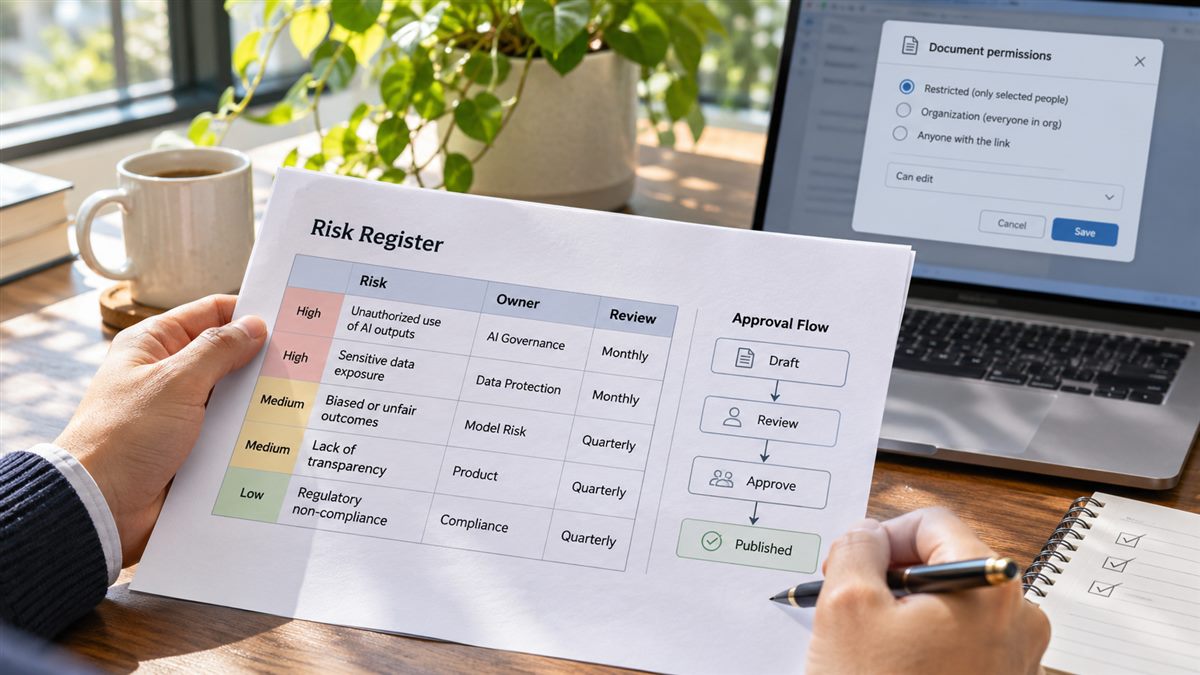
Name an owner with authority to act
Give the use case a business owner who can explain the intended benefit and accept responsibility for how it operates. Identify the technical owner who maintains the integration, and the reviewers needed for the information and decisions involved. These roles can overlap in a small organization, but the responsibilities should remain clear.
Write down who can authorize a release and who can suspend it. A person receiving an incident alert needs enough authority to do something useful. If every change must wait for a committee that meets infrequently, define a narrower emergency process in advance.
Keep the record short enough to maintain. A useful starting entry contains the service name, owner, approved purpose, data sources, users, release conditions, and escalation contact. Add detail where the actual risks require it.
Set boundaries for data and permissions
List the information the model needs for its approved task. Ask whether the same result can be achieved with less sensitive or less detailed input. Confirm the provider’s relevant terms and configuration rather than assuming that every account or product handles data in the same way.
Access should follow the user’s legitimate permissions. If an assistant searches internal documents, check what each user may retrieve and what the system may include in a response. A summary can disclose information just as a copied document can.
Separate read access from permission to take action. Drafting a support reply is a different capability from issuing a refund. If a model can call tools, document which actions require a person to review the destination, amount, or affected record before submission.
Evaluate the task before expanding the rollout
Build a set of examples that reflects the work the system will actually receive. Include ordinary requests, ambiguous ones, and cases where the correct response is to ask for help. Keep the expected outcome and the reason for it with each example.
For the support assistant, evaluation might ask whether an answer uses the current policy, invents a promise, or exposes another customer’s information. A single overall satisfaction score would hide those distinct failures. Decide which failures block release and which require further investigation.
Use a consistent comparison when changing the model, instructions, or source documents. If the test set changes at the same time as the system, an apparent improvement may be difficult to interpret. Record the version and configuration used for each evaluation.
| Decision | Example evidence | Suggested owner |
|---|---|---|
| Can the pilot begin? | Approved purpose, data boundary, and access checks | Business and technical owners |
| Can results reach customers? | Task evaluations and defined human review | Service owner |
| Can the system act automatically? | Action limits, confirmation rules, and recovery process | Accountable operational owner |
| Should operation be suspended? | Incident evidence and predefined stop conditions | Named incident lead |
These are suggested assignments for the example, not requirements imposed by NIST. Adapt them to the organization and the decisions the service can affect.

Make human review a defined job
“A human checks it” leaves too much unanswered. Specify what the reviewer sees, what they must verify, and how they reject or correct an output. Give them access to the underlying source when the task depends on a factual claim.
Check whether the workload gives reviewers enough time. A process that expects a person to approve hundreds of outputs without evidence can turn review into a reflex. Sample quality checks can help identify that problem, but the team still needs to decide which individual actions require approval.
Train users on the limits of the particular tool. A concise example of a plausible wrong answer can be more useful than a general warning about hallucinations. Show the approved route for questions the tool cannot answer.
Plan for incidents and changing systems
Decide what should be logged and how long it is needed, with privacy and security requirements in mind. Keep enough context to investigate a failure without collecting unnecessary sensitive content. Assign someone to review alerts and recurring complaints.
Write a recovery procedure. It might disable an action capability, route work back to people, or revert to an earlier approved configuration. Test the procedure in a controlled setting so the team knows whether it can actually stop the relevant behavior.
Review the system after meaningful changes, including new data sources, expanded permissions, and a change in the people it serves. A successful pilot with limited access does not establish that a wider deployment has the same risk.
Measure value alongside the cost of oversight
Choose a measure tied to the work, such as the time required to produce an approved reply or the proportion of cases resolved correctly. Include the effort spent reviewing and correcting outputs. A faster first draft may provide little benefit if checking it takes longer than the original task.
Keep a route for users to report problems and suggest improvements. Governance can support useful experimentation when people know the permitted scope and can get a timely decision about a change. Our business articles and guide to software modernization planning provide related context for assigning ownership during technical change.
Frequently asked questions
Does governance mean banning AI tools?
No. It means deciding how a particular use is approved, operated, evaluated, and corrected. The permitted scope depends on the task and its risks.
Is the phrase a verified Twitter quotation?
No original post is established here. Attribute it to a person only when you can check the original post and its context.
Is a written AI policy enough?
A policy needs operational decisions behind it: owners, permissions, review criteria, incident handling, and a process for changes.
Should every project use the same approval process?
Use a process proportionate to what the system can access and affect. Document why the chosen controls fit the intended use.



Best Wireless Earbuds Under $200 in 2024: 7 Top Picks for Sound, ANC and Battery Life

Heather Arranie on HealthSciencesForum: How to find and read the articles

Best Shapewear for Desk Jobs: What Doesn’t Dig In, Roll Down or Show Through After Eight Hours

BacktoFrontShow pricing: What Basic, Pro and Enterprise cost

Tech On Dicas: Which site are you looking for?
-

 Entertainment2 months ago
Top Movies and TV Shows in the US: JustWatch September 2026 Streaming Charts
-

 Business2 months ago
How to Choose an Ergonomic Office Chair for Women That Actually Fits
-

 Home Improvement2 months ago
5 Best Indoor Air Quality & Mold Companies in Houston (2026)
-

 Tech2 months ago
The Spreadsheet Habit That Quietly Breaks Business Dashboards as Teams Scale